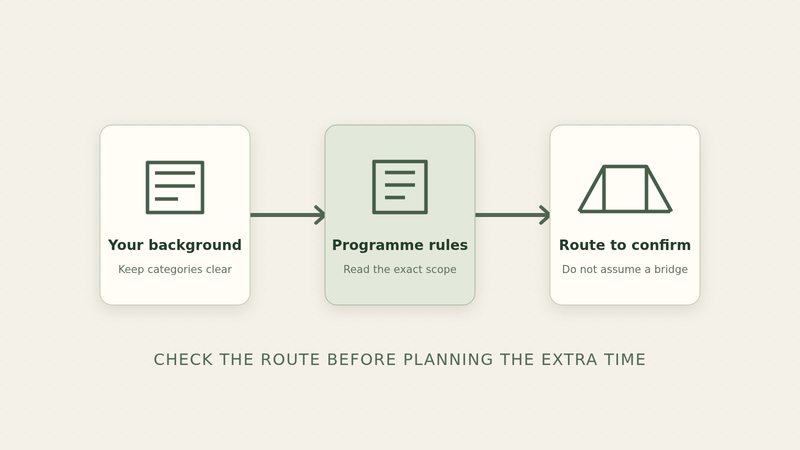
For an Oxford research master's, permission to submit a thesis later does not establish how the extra period will be paid for. Academic time, University charges, college charges and a funding award answer different questions. A workable extension plan needs to connect them without treating one decision as approval of all the others.
This guide uses Oxford's public research-student and fee guidance checked on 7 November 2026. Its scope is research degrees such as the MSc by Research and MLitt, not a general extension rule for a taught master's dissertation. No student's extension, scholarship, fee waiver or immigration position is assessed.
Put the academic decision beside the funding decision
Oxford's postgraduate research changes-of-circumstances guidance describes an extension application supported by a completion plan and supervisor comment. It separately says that extending funding is not guaranteed and may require an application to the funder. It also flags visa planning where the requested study period would outlast current permission.
Those are dependencies to investigate, rather than reasons to assume an extension is either impossible or fully financed. Start with the actual question: what research remains, what additional time is being requested and which decision has been recorded?
Keep the proposed completion date separate from an approved one. In another line, record the funding body's response, the period it covers and any conditions. A supportive discussion is useful preparation, but it should not silently become a confirmed receipt in the budget.
If you are considering applying for a research degree rather than already enrolled, this is a resilience question for the original study decision. What would happen if research took longer than your funding? The answer should come from your actual proposed award and programme, not an imagined automatic extension.
Distinguish fee liability from the time you expect to study
Oxford's fee-liability guidance distinguishes course-fee liability from possible continuation and other charges. It explicitly lists MSc by Research separately from MSc by coursework. Do not use the familiar MSc title to import the wrong fee timetable.
In your record, write the exact qualification, study mode, department, college and relevant academic year. Add the applicable fee-liability period from the actual arrangements. A course duration, a thesis deadline and a fee-payment period should remain separate entries until the evidence connects them.
This also helps you compare research options before accepting an offer. A headline annual fee cannot explain every cost that might arise later. Identify the boundary of the original estimate and the questions that remain outside it; do not turn an unknown charge into zero merely to make two courses look comparable.
Check University and college continuation charges separately
The continuation-charges page publishes University rates by academic year and describes divisional waivers. It separately lists college charges with differing payment conditions. An amount on that page is not, on its own, a determination of your bill.
For example, the full-time University rate shown for 2027/28 is £680 per term. That is one published rate for one year, not the total cost of an extended research master's or a statement that every student owes it. Check the relevant division, stage of study and any applicable waiver before inserting a payable amount.
Then check the college line independently, including its period and payment conditions. Do not assume that a University waiver also cancels a college charge. Equally, do not combine an annual figure and a termly figure without first identifying the periods they represent.
Build the cash plan around commitments, not labels
Use one row for each cost during the proposed extra period. Record the amount, currency, period covered, payment date and evidence. Leave a charge unresolved where its applicability or amount is still being clarified.
Next add living commitments from their own terms: accommodation, everyday costs and any obligations that continue. A continuation charge does not replace rent. Conversely, rent already included in an existing housing estimate must not be counted a second time under the extension label.
Use the budget beyond tuition guide for the wider cash calendar and the full-period housing guide to align accommodation dates. Neither determines a particular Oxford bill or releases an existing contract.
On the funding side, separate accessible funds, agreed support and a request still awaiting a decision. Test the plan with unconfirmed funding excluded from essential receipts. The resulting gap is a question to resolve before committing; it is not a recommendation to borrow more or a prediction that support will be refused.
Keep one extension evidence record
Before relying on additional study time, complete these fields:
- Academic position: the exact research degree, current submission limit, requested period and recorded decision.
- Research plan: the outstanding work, realistic sequence and supervisory feedback.
- University charges: the applicable year, liability stage, rate and any supported waiver.
- College charges: the separate amount, payment period and conditions still to clarify.
- Funding and living costs: confirmed support dates, continuing commitments and any unfunded gap.
- Permission and next action: immigration or other approvals requiring advice, the responsible team and the next review date.
This is an original planning record, not Oxford's application form. Share personal financial, health or immigration evidence only through the appropriate private university or professional process. You do not need to publish those records to identify an unresolved dependency.
Test whether the research goal remains feasible
A hypothetical student may have a credible revised thesis plan but no confirmed additional funding. Another may have money available but no academic extension decision. These are different planning states; neither can be solved by copying the other's confirmed item into the missing column.
Keep the taught-or-research master's comparison alongside the original course choice. Research work can be valuable without guaranteeing a job or making every additional period affordable. Do not cover an unresolved gap with assumed employment income or assume that an academic extension changes work permission.
Your next action is to take the outstanding dependency to the responsible team while there is still time to plan. Keep the recorded academic decision, applicable charges and funding response together, then revise commitments from those facts. Extra time is useful only when the research and the practical arrangements can be supported.
Prepared with AI assistance from the linked current primary sources. The cash-planning method, evidence record and hypothetical comparisons are original editorial interpretation. No individual academic, financial, waiver, visa or employment outcome is guaranteed.