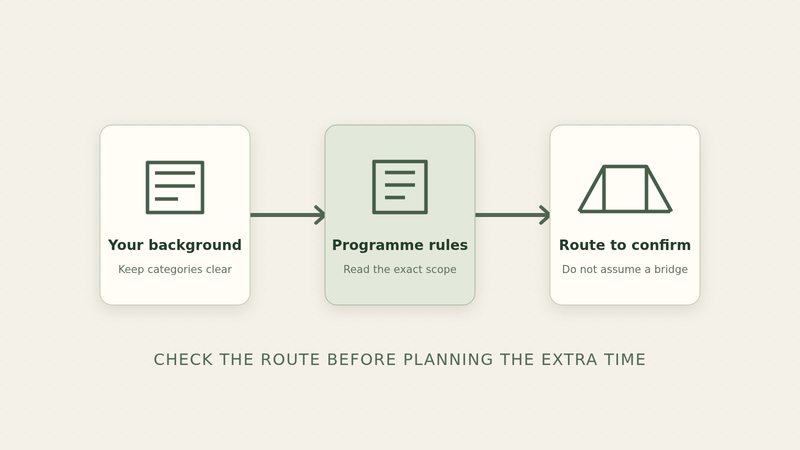
Separate the total study cost from the money available at each payment date, and keep uncertain funding out of the base plan.
A tuition figure is a starting point. An affordable plan also needs to show the other costs, the dates on which payments are due and when your funding will actually become available.
Build the budget in two layers: the total cost of the plan and the cash needed at each stage. This makes it easier to spot a funding gap before a payment deadline arrives.
List costs by stage
Begin with preparation and application costs. Then list tuition and compulsory fees, travel, initial accommodation, insurance and the everyday expenses of living and studying.
These are prompts to investigate, not a universal list of mandatory charges. Check the official information for each institution and destination.
Record the currency and source beside each amount. Mark whether it is a confirmed charge, a current quotation or your own estimate. An empty cell labelled “confirm” is more useful than an invented number.
Put the dates beside the amounts
A family may have enough resources overall but still face difficulty if a deposit is due before a loan is disbursed. A scholarship might reduce tuition while leaving arrival costs to be paid from another source.
For each item, record its due date and the date the proposed funding can be used. Ask the relevant institution or lender about any conditions that must be met first.
Do not assume that money approved, promised or held in an asset is immediately available for a particular payment.
Separate costs from funding
Keep a cost table and a funding table. If a deposit will be credited against tuition, count it once in the total while retaining its earlier payment date. Keep different currencies separate until you have recorded a conversion assumption. In the funding table, distinguish personal funds, documented awards, approved borrowing and support that is still uncertain.
A loan supplies funding and creates a repayment obligation; it does not make the underlying study cost disappear. A scholarship may reduce some costs, but the award's scope and conditions determine how it affects your plan.
Read the award terms rather than subtracting the headline value automatically. Check which period it covers, how it is paid and what is required for renewal.
Test the plan without optimistic assumptions
Create a base case using confirmed support. Put hoped-for scholarships or future earnings in a separate scenario. This is a planning choice, not a prediction that those opportunities will or will not happen.
Then ask what changes if accommodation costs more than expected, a payment comes earlier or funding is delayed. Choose and label your own contingency assumptions. Do not present a convenient percentage as a universal recommendation.
If the plan only works with uncertain income, identify the decision that depends on it before making a commitment.
Compare complete options
Use the same categories when comparing courses of different lengths. A first-year total cannot fully explain the cost of a longer programme. Consider remaining years and any published changes in charges, while clearly distinguishing confirmed figures from estimates.
Avoid describing one country or institution as affordable for everyone. Affordability depends on the specific course, personal circumstances and reliable funding.
Finish with a decision record
Your worksheet should show total expected costs, confirmed funding, borrowing, uncertain support and the next payment shortfall. Add an owner and a date for each unresolved question.
This gives a family conversation a practical focus: what is known, what still needs checking and which commitments should wait. The most useful budget is one you can update and explain, not the one with the smallest headline total.
Keep visa evidence separate from actual spending
The financial evidence for a visa and your practical spending plan answer different questions. Record applicable official requirements separately; this worksheet does not determine whether you meet them.
Study Australia’s living and education costs guidance says actual Australian living costs may be higher than the amount required for a visa. Its calculator is an approximate guide, and the page identifies its cost inputs as last updated in November 2023. Use current local quotations for your own intended place and period. This Australian example is not a visa rule or cost estimate for other destinations.
Worksheet
Study budget and cash-timing worksheet. Copy it for your own private planning.
- Planning tool, not a fee quotation, loan recommendation or proof-of-funds assessment. Use one currency per subtotal; do not add currencies together. Mark unknowns “confirm”.
- Cost Register
- Preparation / applications — Period covered: ______; Currency: ______; Amount: ______; Confirmed / quoted / estimated: ______; Source and checked date: ______; Due date: ______; Refund terms to check: ______
- Tuition and compulsory fees — Period covered: ______; Currency: ______; Amount: ______; Confirmed / quoted / estimated: ______; Source and checked date: ______; Due date: ______; Refund terms to check: ______
- Travel / arrival — Period covered: ______; Currency: ______; Amount: ______; Confirmed / quoted / estimated: ______; Source and checked date: ______; Due date: ______; Refund terms to check: ______
- Accommodation and deposit — Period covered: ______; Currency: ______; Amount: ______; Confirmed / quoted / estimated: ______; Source and checked date: ______; Due date: ______; Refund terms to check: ______
- Insurance / other requirements — Period covered: ______; Currency: ______; Amount: ______; Confirmed / quoted / estimated: ______; Source and checked date: ______; Due date: ______; Refund terms to check: ______
- Food / transport / study materials — Period covered: ______; Currency: ______; Amount: ______; Confirmed / quoted / estimated: ______; Source and checked date: ______; Due date: ______; Refund terms to check: ______
- Remaining programme periods — Period covered: ______; Currency: ______; Amount: ______; Confirmed / quoted / estimated: ______; Source and checked date: ______; Due date: ______; Refund terms to check: ______
- Contingency assumption (label basis) — Period covered: ______; Currency: ______; Amount: ______; Confirmed / quoted / estimated: ______; Source and checked date: ______; Due date: ______; Refund terms to check: ______
- Avoid double counting a deposit credited against tuition: show its earlier due date, but count it only once in the programme total.
- Funding Register
- Personal funds — Currency / amount: ______; Confirmed or uncertain: ______; Available date: ______; Restrictions / conditions: ______; Written evidence: ______
- Confirmed award — Currency / amount: ______; Confirmed or uncertain: ______; Available date: ______; Restrictions / conditions: ______; Written evidence: ______
- Borrowing (not savings) — Currency / amount: ______; Confirmed or uncertain: ______; Available date: ______; Restrictions / conditions: ______; Written evidence: ______
- Uncertain support: scenario only — Currency / amount: ______; Confirmed or uncertain: ______; Available date: ______; Restrictions / conditions: ______; Written evidence: ______
- Cash Check, In A Single Chosen Currency
- Cash check 1 — Payment date: ______; Cumulative costs due: ______; Cumulative usable confirmed funding: ______; Gap = max(0, costs minus funding): ______; Action / owner / date: ______
- Cash check 2 — Payment date: ______; Cumulative costs due: ______; Cumulative usable confirmed funding: ______; Gap = max(0, costs minus funding): ______; Action / owner / date: ______
- If converting currencies, record rate, source, date and transfer-charge assumption. Keep original amounts. Do not allocate one funding amount to multiple payments. Check restrictions before treating funds as usable.
- Summary: total expected cost ____; confirmed non-loan funding ____; borrowing ____; uncertain support (excluded from base) ____; earliest unresolved gap ____.
- Separate borrowing review: repayment start, interest treatment, charges and instalments must be checked in the lender’s written terms. This worksheet does not calculate repayments.
Frequently asked questions
Is a loan a saving?
No. Borrowing is a funding source with a repayment obligation, not a reduction in the price of study. Keep it separate from personal funds and awards. Before relying on it, check the written conditions, disbursement timing, interest and charges, and assess the repayment commitment separately from this budgeting worksheet.
Should expected part-time income go in the core budget?
For a cautious planning base, keep unconfirmed future earnings in a separate scenario rather than using them to close an immediate payment gap. This is an editorial planning method, not a prediction about employment. Any right to work, hours restriction or employer opportunity must be checked separately for your circumstances.
How do I account for scholarships?
Read the actual award terms. Record the covered costs, amount, period, conditions and payment mechanism. A tuition reduction and a cash payment at a later date affect your plan differently. Until an award is confirmed, show it as uncertain support rather than automatically subtracting it from the base cost.
Why does timing matter?
Resources can be sufficient overall yet unavailable when a payment is due. Compare each deadline with the date the relevant money can actually be used and any conditions attached. A promised or approved amount is not necessarily spendable immediately. The worksheet’s cumulative gap check helps you identify where clarification is needed.
Should I compare only the first year?
Compare the full expected programme period using the same cost categories, then examine cash needs by stage. Keep future estimates separate from confirmed charges and show the assumptions behind them. A first-year price is useful information, but it is not a complete cost comparison for programmes of different lengths.
Public source and scope
Study Australia’s official living and education costs page was checked 18 November 2026. Its Australian example is limited to approximate cost guidance and the distinction between actual living costs and visa evidence. The cost, funding and cash-gap registers are original planning methods, not individual financial advice or proof-of-funds assessments.
Related planning guides
- Check deposit and refund conditions
- Test an exchange-rate scenario
- Review borrowing separately
- Prepare for a useful counselling conversation
Prepared with AI assistance. No current fee, visa threshold, scholarship probability, loan rate or employment outcome is estimated here.