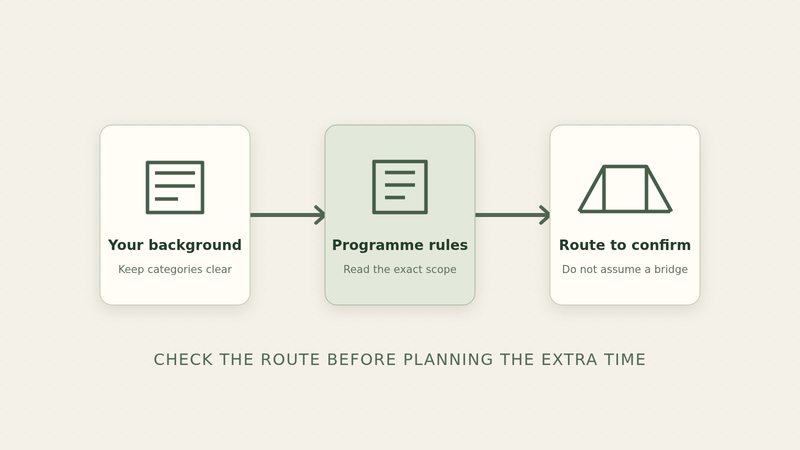
Bring a clear account of your goals, background and constraints, then leave with named actions rather than an unexplained list of universities.
You do not need a finished plan before speaking to a counsellor. You do need a clear account of what you know, what you are unsure about and which constraints affect the decision.
A one-page meeting brief can help you use the conversation well. It also makes it easier to distinguish a preliminary suggestion from a recommendation that has been checked.
Start with the purpose of study
Describe what you want to learn or change. You may have a specific subject in mind, several interests or only a career question. Say which applies.
If your main concern is choosing between subjects, make that the first topic rather than asking for a list of countries. If you already have a preferred course, explain why it interests you.
Be open about uncertainty. A useful conversation clarifies the question before trying to answer it.
Present your background accurately
List completed and ongoing qualifications, relevant subjects and the scale used for your results. Include prior study even if it seems unrelated. Summarise relevant work or training without inflating its scope.
UCAS's UK mature-applicant guidance highlights the importance of demonstrating readiness and discussing qualifications with admissions where necessary. It does not mean an adviser can decide that experience waives a programme's requirements. UCAS
You can begin with a summary and ask which documents are needed for the next assessment. Share actual documents through an appropriate private channel.
Explain timing and constraints
Give your preferred intake and any reasons the timing matters. Separate a preference from a deadline that is fixed.
Mention practical constraints that affect the options: a study format you need, family considerations or a subject prerequisite you may have to complete. Provide only the sensitive detail necessary to assess the question.
If two answers conflict, clarify them. A budget for tuition alone is not the same as a total budget, and an interest in a country is not necessarily a firm decision.
Discuss funding in clear categories
State what is confirmed, what would require borrowing and what depends on an award. Ask for a total-cost comparison rather than a tuition figure alone.
For your own budget, separate tuition, compulsory fees and living costs. Ask each institution for current figures for your intended course and study period.
Do not ask an adviser to make the plan work by assuming an unconfirmed scholarship or guaranteed job.
Ask how the shortlist was made
Request the criteria behind each option: academic fit, prerequisites, curriculum, timing and cost. Ask which institutions were considered and what remains to be verified.
A preliminary recommendation should be labelled as such. Ask where you can check the current official programme information and who will confirm eligibility.
Also clarify the adviser's service scope and any fees before committing to paid work. Guidance, document review and completing an application are different responsibilities.
Finish with an action record
Write down the agreed next step, the person responsible and the date for an update. List questions still open rather than treating the end of the meeting as a completed decision.
A useful first meeting may produce a shortlist, a document request or a plan to investigate your interests. Its value is the clarity it creates: what you are trying to achieve, what evidence is needed and what happens next.
Worksheet
First counselling meeting: working brief. Copy it for your own private use.
- Complete what you know; use “unsure” where necessary. Keep this copy private. This is not an application or a data-collection form.
- What I want to learn/change — Your notes: ______; What needs checking: ______
- Subjects I want to explore — Your notes: ______; What needs checking: ______
- Qualifications, status and results scale — Your notes: ______; What needs checking: ______
- Relevant work/training — Your notes: ______; What needs checking: ______
- Preferred intake and fixed constraints — Your notes: ______; What needs checking: ______
- Total budget, currency and period covered — Your notes: ______; What needs checking: ______
- Confirmed funding / borrowing / uncertain awards — Your notes: ______; What needs checking: ______
- Study format and practical constraints — Your notes: ______; What needs checking: ______
- My three main questions — Your notes: ______; What needs checking: ______
- Shortlist check: use current official programme information and keep unconfirmed requirements visible.
- Shortlist option 1 — Option: ______; Why it fits: ______; Official course URL / checked date: ______; Requirements still unconfirmed: ______
- Shortlist option 2 — Option: ______; Why it fits: ______; Official course URL / checked date: ______; Requirements still unconfirmed: ______
- Meeting close: agree an action, responsible person, date and evidence needed.
- Meeting action 1 — Next action: ______; Responsible person: ______; Agreed date: ______; Evidence needed: ______
- Meeting action 2 — Next action: ______; Responsible person: ______; Agreed date: ______; Evidence needed: ______
- Before paid work: record the service scope, fee, exclusions and who submits the application. Do not include passwords, full financial account numbers or identity-document copies here.
Frequently asked questions
Do I need to know the country first?
No. Start with the subject or career question you want to explore and any constraints that matter. A country preference can be one input, not the whole decision. Ask how the eventual options fit your academic background, intended learning, timing and funding before treating a shortlist as final.
What if I am unsure about the subject?
Say so directly and make subject exploration the purpose of the meeting. Bring examples of work or learning you enjoy, and questions you want answered. The next useful step may be comparing course modules or investigating a field, rather than choosing a university during the first conversation.
Should I send every document before the first call?
Begin by asking what is necessary for the meeting and why. A concise summary may be enough for an initial discussion; a formal assessment may need particular documents. Check the recipient and private submission channel before sending them. Do not place identity documents or financial records in a public form or shared worksheet.
What should I ask about the shortlist?
Ask why each option was included, which alternatives were considered and which requirements remain unchecked. Request current official course links and distinguish an adviser’s preliminary view from an admissions decision. Also ask whether the adviser’s available institution relationships limit the choices shown, without assuming the answer in advance.
How do I finish the meeting with a useful next step?
Summarise the decision or question that moved forward, then record the next action, its owner and an agreed date. List unresolved eligibility, cost or timing questions separately. You do not need a final university choice to have made progress; a clear evidence-gathering plan can be a useful outcome.
Public source and scope
UCAS: Mature students, your qualifications, checked 17 November 2026. This UK mature-applicant illustration does not establish postgraduate eligibility or an individual waiver. The meeting brief, budgeting prompts and FAQs are original editorial methods.
Related planning guides
Prepared with AI assistance. This guide is not an application, data-collection form or individual admissions, immigration, financial or employment assessment.