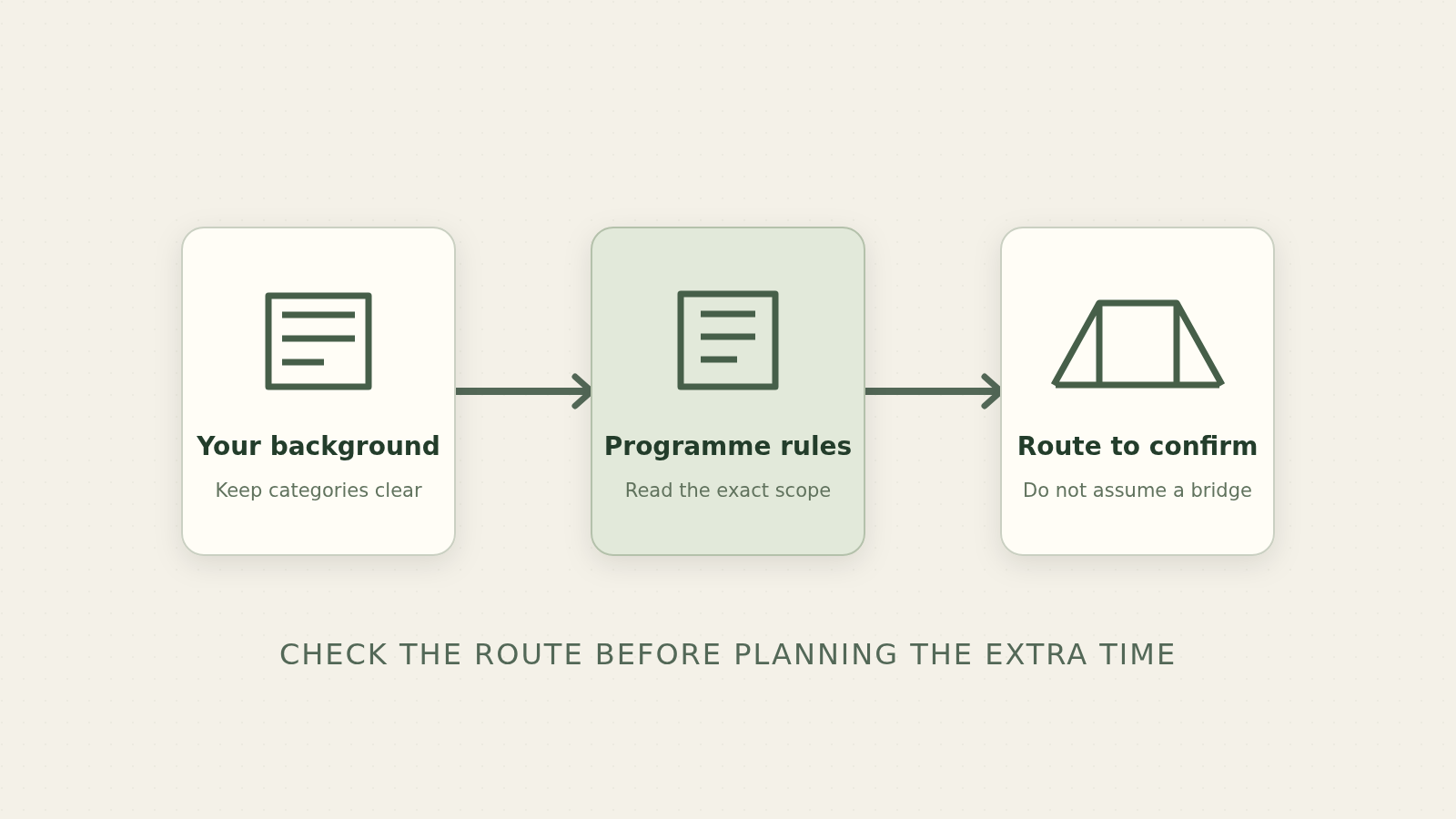
A pre-master's can look like a useful answer when your bachelor's preparation does not quite match the master's you want. Before adding that extra study to your plan, establish whether the particular programme makes the route available to your applicant category.
The University of Twente's Business Administration pages make this a material question for international applicants. Under ‘International education’, its programme-specific pre-master's page says non-EEA international students must apply directly to the master's and cannot participate in this pre-master's. Read that restriction before treating a bridge semester as your fallback. Business Administration pre-master's guidance.
This guide uses official university pages checked on 13 November 2026. It explains a planning decision, not your individual eligibility or the terms of a future admission offer. If your nationality and educational background cross the site's categories, ask the programme to clarify which instructions apply.
Read the general page and the programme page together
Twente's general guidance for applicants with an international bachelor's describes three possible outcomes: direct admission, rejection, or admission dependent on completing a pre-master's. It explains that the university assesses whether missing preparation can be addressed through a programme-specific bridge.
That is a description of possible routes across the university. For Business Administration, the more specific page identifies different educational categories and includes the non-EEA restriction above. You cannot settle availability by selecting the most encouraging sentence from the general page.
Build a short route record before spending time on a bridging plan. Record the exact master's, your intended intake, citizenship, the country and institution awarding your degree, and whether the degree is completed. Keep nationality and place of education as separate fields. Do not label an Indian qualification “Dutch HBO” or “Dutch WO” yourself because the teaching style seems similar.
The programme's admissions overview explicitly says that the application route depends on nationality and educational background. It also leaves the admission decision to the Admissions Committee, assessing each case individually. A route record organises the question; it does not replace that assessment.
Consider a hypothetical comparison between an Indian citizen with an overseas bachelor's and an Indian citizen studying for a Dutch HBO bachelor's. Shared citizenship does not establish that the same educational-category instructions apply. Retain the non-EEA restriction in the International education section, and ask the university to classify the Dutch-qualification case before assuming a route is available.
Identify the gap you are trying to address
Consider a hypothetical applicant who wants a business master's but is unsure whether their earlier studies provide enough preparation in research methods. There are two questions to answer: what evidence does the university require, and what options does it make available if that evidence is insufficient?
Adding six months to a spreadsheet answers neither. Nor does buying an unrelated preparation course establish that the university will recognise it.
Use your transcript and official module descriptions to prepare a compact academic map. For each relevant area, note what you studied, the work you completed and the evidence available. Separate “I have studied this” from “the university has accepted this as meeting its requirement”. Where there is a gap, name it rather than describing your whole degree as inadequate.
Our guide to checking a three-year Indian bachelor's provides a broader qualification worksheet. Its Oxford and UBC examples are not Twente admission rules. Here, the additional decision is whether the particular bridging route is available at all.
Use the eligibility check for its stated purpose
Twente says applicants with an international degree must complete its online eligibility check. The resulting email provides a code for the later application. The university also states that the check is not the official admission decision and creates no entitlement to admission. Follow the current international-degree instructions and select the actual programme you intend to pursue.
Keep the result in your application record, with the details you entered and the date. Do not use a favourable result to erase a restriction shown on the programme page. If the result and the published route appear inconsistent for your circumstances, ask the official programme contact to explain the difference before relying on either interpretation. The programme's international admissions page also explicitly says a negative e-check does not prevent a formal application. That preserves the opportunity for an official assessment, not an entitlement to admission or a pre-master's place.
The university's enrolment guidance says applicants do not apply directly to a pre-master's. They apply to their chosen master's, and the university handles an appropriate transfer to a pre-master's. It also warns that a rejection can cover both routes. A separate bridging application should therefore not be invented as a way around an unfavourable master's decision.
The same guidance separately describes a transfer-minor route for students already pursuing a Dutch bachelor's. That is a distinct route, not a workaround for the published international-applicant restriction.
Check the commitments if a bridge is actually offered
For applicants to whom the Business Administration pre-master's is available, the published expectations include successful completion within one academic year and at most two exam attempts per course. The page also says unsuccessful completion prevents starting another pre-master's within Twente's Faculty of Behavioural, Management and Social Sciences. These are programme-specific progression constraints, not universal Dutch rules. Published pre-master's expectations.
Before accepting an offered route, obtain the actual assigned subjects, assessment timetable, completion conditions and subsequent master's entry arrangements. A useful calendar separates preparation, examination opportunities, the university's completion decision and the proposed degree start. Leave any unconfirmed dates blank instead of filling them with a convenient estimate.
Build the financial plan around that confirmed calendar. Include the extra period of accommodation and living costs, relevant course charges and payment dates. Keep the cost of an uncertain route in a scenario column until the route itself is established. A small quoted course fee can still sit inside a much larger relocation commitment.
Keep language evidence on its own timetable
The Business Administration international admissions page says applications are processed only once the English-language requirement is met. It does not offer conditional admission for an unmet English requirement, and it warns against obtaining the required certificate after the application deadline. Check the current accepted evidence and any officially listed exemption for your own circumstances.
A potential academic bridge should not be used as a reason to postpone this separate requirement. Record when evidence must be available, not merely the day you expect to sit a test.
Finish with a route decision, not a guessed extra semester
Before treating Twente Business Administration as a workable plan, complete these six checks:
- Applicant category: nationality and educational background recorded separately, with unclear classification referred to the programme.
- Route evidence: the specific published rule and any case-specific university clarification retained.
- Academic preparation: relevant subjects and evidence identified, with unassessed gaps still labelled unassessed.
- Application stage: eligibility-check result distinguished from the formal application decision.
- Progression and dates: any offered bridge's actual conditions and timing recorded before extending the study calendar.
- Financial commitment: confirmed requirements separated from scenarios, with no assumption that a bridge, later admission or future income is guaranteed.
The useful next step is a precise question about your applicable route. Once that is clear, you can compare the learning, time and full-period cost with other genuine options.
Prepared with AI assistance from the linked primary university sources. The hypothetical example and planning framework are original editorial interpretation. No personal admission, immigration, employment or financial outcome is confirmed.