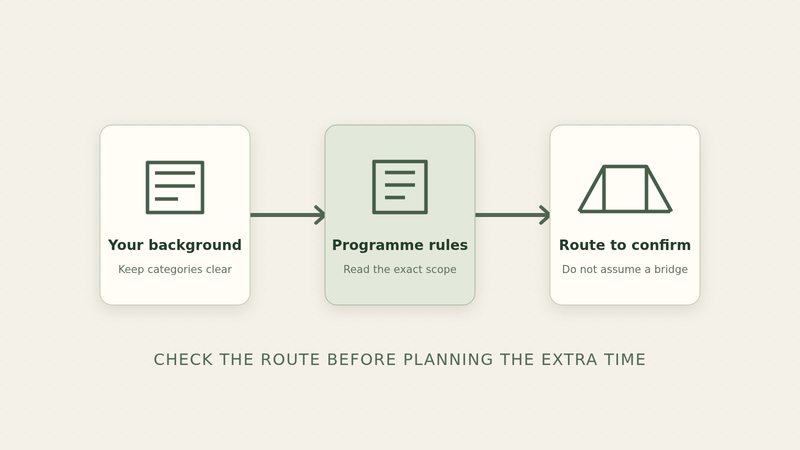
A package name tells you little about who will do the work or what you will pay. Compare the written inclusions, exclusions and responsibilities before choosing support.
A study-abroad quotation can look reassuringly complete and still leave important questions unanswered. “Application support” might mean explaining a form, checking your draft or handling a submission after your approval. “Accommodation assistance” might mean a list of websites rather than a room reservation. Neither phrase tells you the full scope by itself.
Start with a simple comparison: what work will be done, by whom, within which limits, and for what payment? Use the same questions for an inexpensive offer and a premium-looking package. A higher fee is not evidence of better support; a zero service fee is not evidence of poor advice. Your goal is a clear, suitable service, not the longest list of benefits.
1. Separate the adviser’s work from everyone else’s charges
Ask for an itemized, dated proposal rather than relying on the package name. Keep the advisory-service fee separate from university application charges, tuition, examination fees and other third-party payments. If the adviser collects a payment for someone else, ask which organization receives it and what receipt you will receive.
This is not an adversarial question. It helps both sides use the same reference. The University of East London’s student guidance recommends asking what fees cover and which institutions an agent works with. That is UK-focused guidance, not a description of every agency worldwide. Source 1
For each line in your quotation, write “included”, “excluded” or “not yet confirmed”. A blank cell should stay an open question, not quietly become a zero in your budget.
2. Map the service to your actual application journey
Build your comparison around stages, not branded tiers. Useful categories include understanding your goals, researching courses, building a shortlist, preparing applications, following up on offers, discussing funding options, supporting a visa application and preparing for departure. These are questions to ask, not services every provider is expected to supply.
At each stage, identify the level of help:
- Advice: someone explains what you need to do.
- Review: someone checks work you prepare.
- Joint completion: you work through the task together.
- Provider completion: someone prepares or submits specified material, subject to the necessary checks and your approval.
Then name your part. Who obtains transcripts? Who requests references? Who checks that the final form accurately describes your education and experience? Who monitors messages from the institution? Ask to see the final application before submission and retain your own copy.
For a statement of purpose, distinguish feedback on structure and clarity from writing that misrepresents your experiences. Support should help you explain your real reasons and evidence, not create an invented profile.
Make deadlines equally concrete. “We follow up” is less useful than knowing when you will receive an update, which channel to use and who covers an urgent question when your usual adviser is unavailable.
3. Unbundle teaching, preparation and the official examination
Treat language learning and examination services as separate rows. Ask whether the package includes foundation teaching, test-specific preparation, practice exercises, mock tests, booking assistance, the official examination fee or support after an unsuccessful attempt. Confirm the number of classes, teaching format, access period and any limits on feedback.
If the offer includes an examination payment, identify the exact test and version, booking location, payment recipient and arrangements if you need to change the date. Do not assume a retake is included because preparation is included.
As one concrete example, British Council’s IELTS booking guidance distinguishes test type and location and says the fee depends on those selections. It does not establish what an unrelated adviser’s package covers. Source 2
Before paying for a course or test, check the intended institution’s current language-evidence requirements and any separate immigration requirements. Ask whether the proposed qualification is accepted for your specific course and intake. A coaching completion certificate should not be treated as accepted admissions evidence without confirmation from the receiving institution.
4. Find the limits hidden inside broad words
Ask how many applications, shortlist revisions and document-review rounds are covered. Check the support end date and what happens if you change your course, destination or intended intake. If specialist advice is mentioned, ask what kind of specialist, how access works and whether a separate charge applies.
Go through likely extras individually: translations, credential evaluation, document certification, couriers, test fees, insurance, travel and accommodation. Do not assume each item is required for your case. Confirm necessity with the relevant institution or official process before purchasing it.
Keep assistance distinct from the thing being purchased. Help searching for accommodation does not tell you whether rent, a booking payment or a housing deposit is included. Similarly, help preparing a visa application is a service, not an approval. For UK Student visas, the official process separately describes application steps and a decision, including what happens if the application succeeds. Source 3
5. Build a payment picture without hiding uncertainty
Create two subtotals: confirmed payments and estimates. For every amount, record the currency, recipient, due date and what it buys. Keep different currencies separate unless you explicitly show the conversion rate and date used for a planning estimate.
Ask whether quoted service fees include applicable taxes and whether instalments change the total payable. Where there is a promotion, record its eligibility, expiry, exclusions and whether it can be combined with another offer. If the terms are missing, do not deduct the advertised benefit from your confirmed total.
Avoid double-counting. When a payment is credited against a later charge, show both the cash due now and the remaining balance, but count the underlying charge only once. Confirm that treatment in the applicable written terms.
Keep funding on a separate line. Borrowing may change when and how you pay, but it does not make the underlying expense disappear. Assess any interest and financing charges from the actual lender’s terms, not a headline promise of affordable instalments. This worksheet is a comparison tool, not a recommendation to borrow.
6. Understand how the shortlist is built
Ask what criteria connect each recommendation to your goals. Which institutions are considered, and are there limitations to that range? Ask whether commercial relationships affect the available services or recommendations. You can request this explanation without assuming wrongdoing.
Compare the educational fit yourself: curriculum, entry requirements, learning format and the costs you can realistically support. If you already favour an institution outside the proposed shortlist, ask what assistance is available for it. A useful explanation should leave you better able to make your own choice, not simply accept a package’s default options.
7. Finish with one shared written version
Send back your comparison sheet with unresolved cells highlighted. Ask for a dated revision that resolves any difference between a conversation, brochure and quotation. Keep the prior version too, so changes are visible. Record who agreed to the update and what it changes in the work, price or timing.
If an answer remains unclear, pause the affected purchase and ask for clarification. Do not translate a friendly assurance into a promise the written scope does not make. Before choosing, make sure you can explain the service in one sentence: what you are paying for, what you must do yourself and which costs remain outside it.
Worksheet
STUDY-ABROAD SERVICE COMPARISON WORKSHEET
- Copy a separate sheet for each quotation. No personal information needs to be submitted.
- Provider label: ____ Quote date/version: ____ Intended scope/intake: ____
- Use Included / Excluded / Confirm. A blank is unknown, not zero.
- For each entry, record: service item; included?; who does the work?; limit/deadline; provider fee + currency; external fee + recipient/currency; written confirmation; questions.
- Goal/profile discussion — confirm — confirm — confirm — confirm — confirm — quote/version/page: ____ — ____
- Course research/shortlist — confirm — confirm — confirm — confirm — confirm — quote/version/page: ____ — ____
- Application preparation/submission — confirm — confirm — confirm — confirm — confirm — quote/version/page: ____ — ____
- Statement-of-purpose feedback — confirm — confirm — confirm — confirm — confirm — quote/version/page: ____ — ____
- Translation — confirm — confirm — confirm — confirm — confirm — quote/version/page: ____ — ____
- Document checks/certification — confirm — confirm — confirm — confirm — confirm — quote/version/page: ____ — ____
- English foundation coaching — confirm — confirm — confirm — confirm — confirm — quote/version/page: ____ — ____
- Test preparation/mock tests — confirm — confirm — confirm — confirm — confirm — quote/version/page: ____ — ____
- Official examination/booking — confirm — confirm — confirm — confirm — confirm — quote/version/page: ____ — ____
- Language certification/recognition check — confirm — confirm — confirm — confirm — confirm — quote/version/page: ____ — ____
- Loan assistance — confirm — confirm — confirm — confirm — confirm — quote/version/page: ____ — ____
- Visa form assistance — confirm — confirm — confirm — confirm — confirm — quote/version/page: ____ — ____
- Accommodation search — confirm — confirm — confirm — confirm — confirm — quote/version/page: ____ — ____
- Travel/insurance — confirm — confirm — confirm — confirm — confirm — quote/version/page: ____ — ____
- Post-offer follow-up — confirm — confirm — confirm — confirm — confirm — quote/version/page: ____ — ____
- Pre-departure support — confirm — confirm — confirm — confirm — confirm — quote/version/page: ____ — ____
- CONFIRMED PAYMENT SUMMARY (separate totals by currency)
- For each entry, record: Recipient; what it pays for; amount/currency; due date; tax treatment confirmed?; receipt/reference.
- ____ — ____ — ____ — ____ — ____ — ____
- Confirmed subtotal by currency: ____
- Estimates, excluded from confirmed subtotal: ____
- Unpriced items, excluded from totals, not assumed free: ____
- Advance payments credited to later charges: ____ (do not count twice)
- Promotions confirmed by dated terms: ____
- Financing: principal/interest/charges/timing recorded separately; do not subtract a loan as a discount.
- Final unresolved questions: ____
- COMPARISON DECISION
- What work do I need that quotation A omits? ____
- What work do I need that quotation B omits? ____
- What can I comfortably do myself? ____
- Which remaining uncertainty could materially change my cost or support? ____
Frequently asked questions
Does “test preparation included” include the examination fee?
Not unless the written scope says so. Ask separately about teaching, practice tests, booking assistance, the official examination payment and retakes. If an examination payment is included, confirm the exact test, version and booking location. Check the current fee with the official test provider and make sure the intended institution accepts the proposed evidence.
Is visa support the same as visa approval?
No. Compare the support work being offered, such as explaining a checklist or reviewing a form, separately from the authority’s decision. Ask who prepares the application and how you check its accuracy before submission. For example, GOV.UK’s Student visa guidance distinguishes applying from receiving a successful decision. No service description should be read as a guaranteed result.
Does accommodation assistance pay for accommodation?
The phrase alone does not tell you. Ask whether it means search advice, contacting accommodation providers, booking help or a payment towards housing. Confirm whether rent, deposits and any booking charges are included, who receives each payment and the relevant conditions. Keep the assistance fee separate from housing costs unless the written quotation explicitly combines them.
How do I compare a free service with a paid package?
Use the same scope sheet for both. Compare the work, support limits, institutions considered, your responsibilities and external charges. Ask how recommendations are selected and whether commercial relationships affect the service. Do not assume that free means poor advice or that paying means better advice. Choose support that addresses your needs and leaves the educational decision with you.
What should I do if the quoted scope changes?
Request a dated replacement that identifies the changed services, price and timing. Keep the old version and list any difference between the new document and what was said verbally. Ask for the unresolved points to be clarified before relying on the change or making an affected payment. This is a record-keeping approach, not a promise of a legal remedy.
Public sources
Institution-specific examples checked 16 November 2026. Current terms for the exact programme, intake and applicant govern.
Related planning guides
- Study abroad deposit refund checklist
- Masters budget beyond tuition
- Masters application ai policy check
Prepared with AI assistance from the linked primary sources. The worksheets and comparison methods are original editorial tools, not personal admissions, financial, legal or immigration decisions.