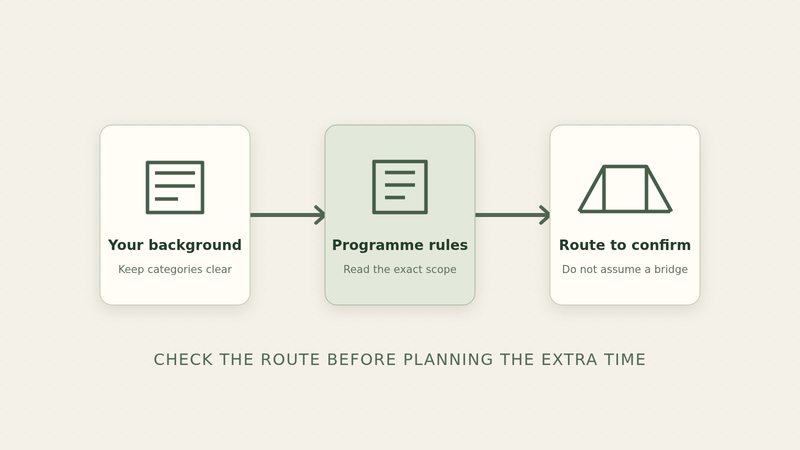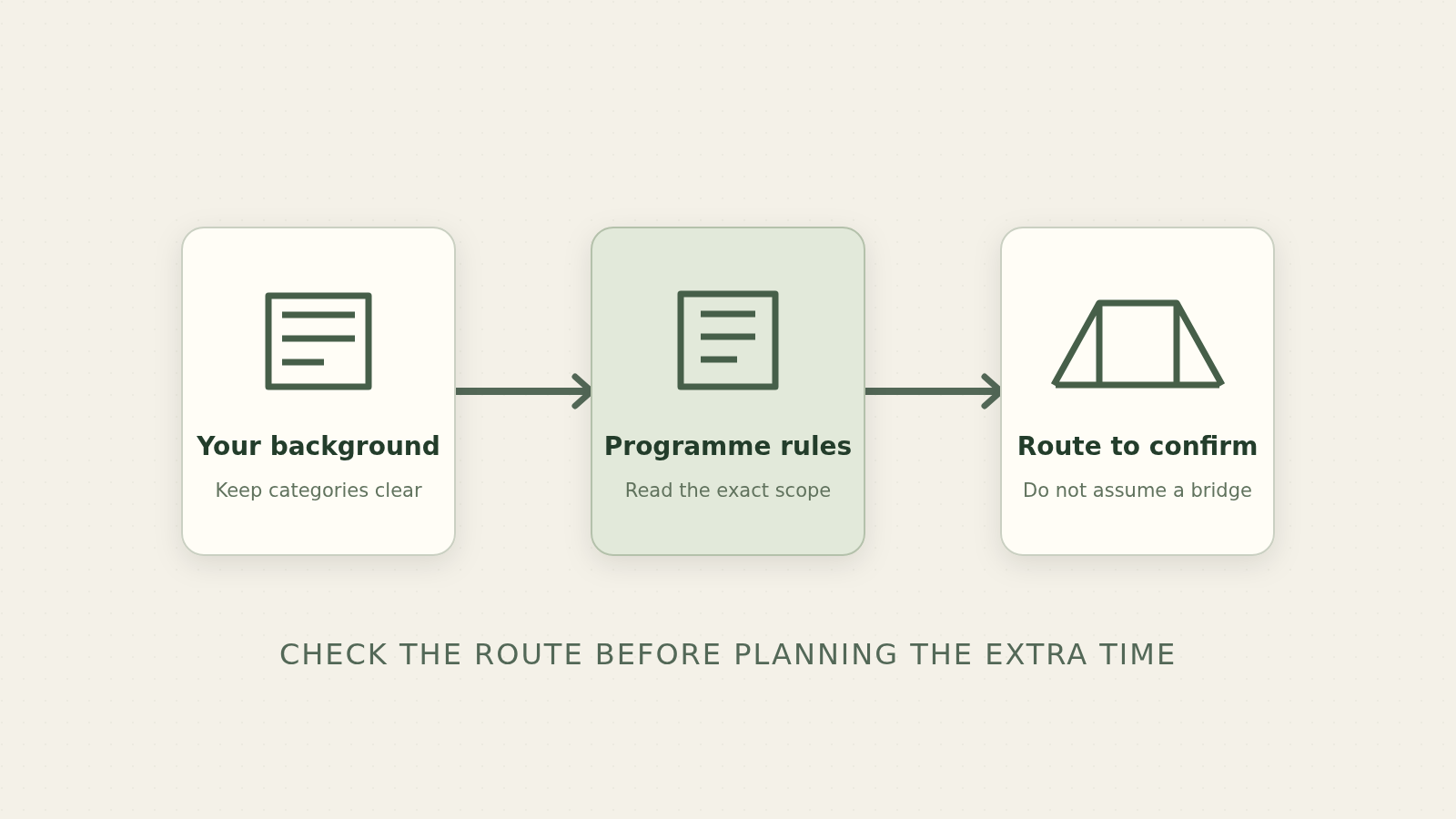
If your bachelor's diploma will arrive after the application deadline, the University of Zurich may still allow you to apply for a master's. That does not mean you can postpone every missing document. Language evidence has a different timetable, including a specific rule for applicants who require a visa.
The useful decision is therefore not simply whether UZH accepts documents later. It is which document, for which applicant and programme, at which stage. This guide checks four current UZH pages on 7 November 2026 and turns those distinctions into an original preparation record. It does not assess an individual application or give permission to leave a required field incomplete.
Start with the application you actually intend to submit
UZH's documents-to-submit page distinguishes requirements by study level, educational background and programme type. It directs applicants to the applicable fact sheet and says a later submission option will be noted where available. An applicant with a foreign qualification should not copy a checklist intended for a different educational background or degree level.
Use the current fact sheet and application instructions for your actual route to build the list. This article does not reproduce the fact sheets or establish a universal document bundle. A list saved by another applicant can help you notice a question, but it cannot decide what your own application requires.
Keep the university's wording beside each item. A final diploma, a language certificate and an academic transcript are different evidence, even when all three appear on the same screen. Do not rename them collectively as documents still pending and assume one exception covers the whole group.
The degree diploma has a specific later-submission provision
The central master's admission page says the bachelor's diploma need not necessarily be available at application. For admitted applicants, it gives later submission limits of 30 September for fall admission and 15 March for spring admission. The pending-documents FAQ also describes the degree provision and warns of withdrawal from the university if the relevant degree is not submitted.
These are limits tied to the semester of admission, not a new general application deadline. They do not prove that your degree will be accepted, that you will be admitted or that any particular temporary document is an approved substitute. Follow the actual instructions and decision for your case.
Check the programme's start options before building a spring plan. The central page warns that many mono and major programmes do not offer a spring start. A March date in the general diploma rule does not establish a spring intake for the programme you want.
Language evidence follows a separate timetable
The language-requirements page states that applicants requiring a visa must provide a recognised language certificate by the application deadline for that category. Without it by that deadline, the application will not be processed further. Other prospective students may submit after admission, but no later than one week before courses start; matriculation depends on the certificate being available.
The distinction is consequential. Do not transfer the later diploma date to language evidence or assume that an intended test booking meets the certificate requirement. Check whether the evidence itself is recognised, not merely whether a test date is available.
The page also sets out language-proof exemptions. Having studied some subjects in English is not, by itself, a determination that your circumstances satisfy one. Read the stated conditions and resolve uncertainty through the official process. This guide does not classify your visa requirement, award an exemption or substitute its own test-score table for the university's current one.
Compare two hypothetical preparation states
In the first, an applicant's final diploma will be issued later, while the other required application evidence is available. The published diploma provision gives that applicant a concrete issue to check against the intended admission semester and formal instructions. It does not predict the admission decision.
In the second, an applicant requiring a visa has a language test scheduled after the relevant application deadline. The diploma's later-submission provision does not resolve that missing language evidence. The next step is to reassess the actual evidence and feasible application plan, rather than label everything conditional and proceed on an assumed exception.
Both comparisons are editorial illustrations, not real student cases. Their value is identifying which fact would change the plan. No applicant documents, scores or personal records were used.
Keep a document-by-document decision record
Before relying on a later submission, complete these fields:
- Route: the exact master's programme, intended semester and relevant educational-background checklist.
- Evidence: the precise document name and instruction, without combining unlike items.
- Category: the applicable visa-requirement position or the official question still unresolved.
- Timing: the application deadline and any specifically supported later submission limit.
- Availability: when the issuer expects to provide the evidence, distinguished from when you hope to receive it.
- Action: the missing clarification, official submission route and next review before committing money.
The FAQ says mandatory items marked in the form belong with the application by its deadline, and missing additional documents can delay processing. Later submission is therefore not a promise of immediate assessment. Keep the original instructions and any subsequent official request together so that a changed deadline does not disappear from your record.
Connect document timing to the whole study decision
For academic preparation in a combined degree, our UZH major–minor guide asks a different question: how prior coursework and formally assigned requirements affect the proposed combination. A complete document set does not establish academic fit, just as an academic plan does not settle document timing.
Use the offer-conditions guide to track the actual decision if one arrives. Update the budget beyond tuition only with a study period and commitments you can support. Do not make unresolved admission or arrival timing affordable on paper by assuming immediate paid work.
Your next action is to separate the missing evidence into individual rows and identify the rule supporting each proposed delay. If the rule or applicant category is unclear, keep that row unresolved. The university's process determines what is acceptable; this record helps you ask a precise question before a deadline or financial commitment.
Prepared with AI assistance from the linked current primary sources. The record and hypothetical comparisons are original editorial interpretation. No admission, language exemption, visa, employment or individual qualification outcome is guaranteed.