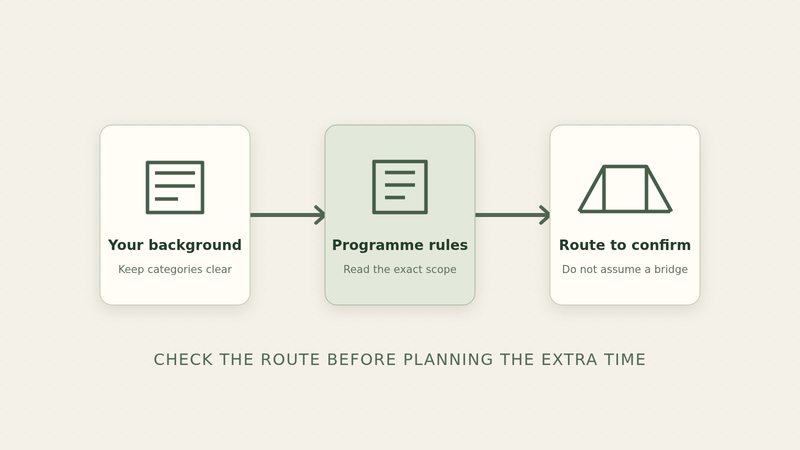
A student room described as a “licence” is not enough information to determine whether it falls within Ireland's Residential Tenancies Board, or RTB, remit. The RTB's student guide includes student-specific accommodation licences within its system, while listing a room in the landlord's own home, often called “digs”, outside it. The actual arrangement matters.
This guide checks three official RTB pages on 6 November 2026: student renting, student-specific accommodation and who should register. It concerns the Republic of Ireland and a pre-commitment information check. It does not classify an individual property, interpret your contract or determine a dispute.
Start with the living arrangement, not the document heading
The RTB explains that the substance and terms of an arrangement matter when distinguishing a lease from a licence. A heading selected by a provider does not settle that assessment.
For a master's applicant comparing rooms from abroad, begin with concrete facts. Who provides the accommodation? Does the person offering it actually live there? What space would you occupy, and what would you share? What access and room-use arrangements are proposed?
Keep those answers separate from the advert's labels. “Student room”, “private accommodation” and “licence agreement” can describe different things. A university-oriented marketing page or a familiar platform name does not establish the legal status of the actual arrangement.
Obtain the applicable written terms before relying on an interpretation. If the facts are incomplete or inconsistent, mark the status unresolved and use the official advice route for the actual case. Do not turn a short property description into your own legal determination.
Student-specific accommodation is a distinct category
The RTB describes student-specific accommodation, or SSA, as accommodation used solely for students during the academic term or year. It can be provided by a university, college or private company.
A standard private rental does not become SSA merely because the person renting it is a student. That distinction matters when reading rules intended specifically for student accommodation. First establish which category applies; then consult the current rules for that category.
The SSA page also describes an exception involving an individual landlord living in the same building, or part of it. If that could describe the proposed property, get its actual status checked. Do not assume a photograph, a corporate provider name or someone's presence on site supplies all the facts.
A family comparing two offers should therefore preserve the exact provider and arrangement for each option. Do not copy the apparent rights or requirements of a campus residence into an unrelated private room.
A room in someone's home needs a different comparison
The RTB's student table treats digs or rent-a-room accommodation in the landlord's own home differently from SSA and ordinary private tenancies. Its registration and dispute-resolution columns are different.
That is a reason to understand the arrangement, not to declare every licence unsuitable or every room advertised as student accommodation protected in the same way. It also does not establish every right or remedy that might apply outside the RTB system.
For daily life, ask which spaces and facilities you may use, whether meals or utilities are included, how access is arranged, what house rules apply and how concerns would be raised. Establish these matters in the actual agreement rather than assuming that another student's experience carries over.
Consider how the arrangement fits assessed study. Would the agreed use of the room and shared facilities support your working hours, online meetings and ordinary routines? These are fit questions for your circumstances, not claims that one housing type produces better academic results.
Registration is another check, not a substitute for classification
The RTB provides an official registration-check route. Its registration guidance also says that a landlord's failure to register does not by itself prevent a tenant using its dispute-resolution service.
A missing register result should therefore prompt clarification rather than the conclusion that no protection exists. Equally, registration information should not replace reviewing the actual terms and applicable category. Do not infer a personal dispute outcome from a general website summary.
Keep the relevant evidence privately: the agreement version, what was represented about the accommodation, written answers, an inventory where applicable and payment receipts. Avoid publishing the address, another resident's details or private correspondence in a public forum to obtain an informal verdict.
This article has not searched an individual property or assessed a landlord. Use the RTB's current guidance and appropriate case-specific advice when the arrangement remains unclear.
Compare the full housing period and cash commitments
Once the arrangement is understood, match its actual start and end dates to the period you need a home. A course or residence described by an academic-year label does not establish accommodation for every month of a master's.
Use our full-period housing guide to record the study calendar, housing dates and any unresolved gap. Do not assume an extension, replacement room or refund will be available.
Build the cost comparison from the written terms: rent, included services, separately payable bills, deposits and payment timing. Check the current official rules that apply to the identified category before committing. This guide does not turn an estimated total into an approved payment request.
Keep unconfirmed part-time earnings out of the funds available to secure housing. The budget beyond tuition guide helps separate committed costs from uncertain income and refundable amounts. For a family supporting the plan, an unresolved agreement or housing gap belongs in the decision discussion.
Make one evidence record before deciding
For each actual option, complete these lines:
- Arrangement: provider, proposed occupancy and whether the landlord lives there.
- Category: the current RTB guidance considered and any unresolved classification.
- Terms: room and shared-space use, services, access, house rules and exit questions.
- Commitment: housing dates, written payments, what is refundable and what remains unknown.
- Verification: viewing, written answers, relevant registration check and the advice still needed.
This is an original planning aid, not a legal classification test. The RTB's student guidance prioritises viewing a property before transferring money and retaining written records. Pressure to pay should not replace those checks.
Your next action is to resolve the material unanswered question for the actual offer before treating its rights, costs and living period as settled. A clear document title is useful; it cannot replace the facts of the arrangement.
Prepared with AI assistance from the linked primary RTB guidance. No private listing, student story, tenancy outcome, accommodation availability or individual legal assessment is represented.