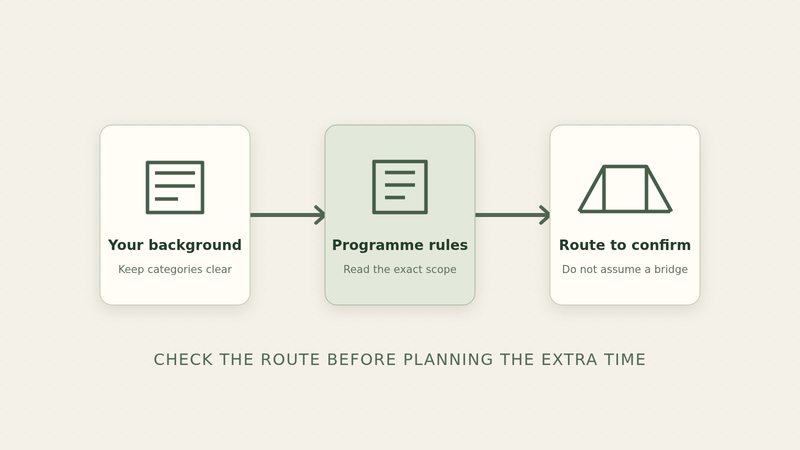
For a fee-liable applicant to a Finnish master's, the national application fee can cover more than one application for the same study-start term. That does not give every application a fresh payment window. Track the earliest payment deadline as well as the term the payment covers.
This guide is for applicants who are required to pay the fee. It does not determine anyone's citizenship, residence-document exemption or eligibility for a particular programme. The Finnish National Agency for Education's public Studyinfo instructions and official 2027 planning guidance were checked on 4 November 2026.
Separate the fee from the study budget
The official 2027 admissions guidance says applicants from outside the EU, EEA and Switzerland are generally required to pay a €100 application fee. Use the authority's detailed rules to establish whether you are liable; a nationality label alone is not a review of every possible exemption.
Treat this as a cost of applying, not tuition paid in advance. Payment does not establish an admission offer or scholarship. The Studyinfo application-fee instructions also state that the fee is not refunded when an applicant withdraws, receives no place or is found ineligible.
Keep it on the application-stage cash calendar, separate from any later tuition invoice, housing payment or residence-permit cost. A family should be able to see which money is committed before an admissions decision and which later costs remain conditional. Our full-course budget guide keeps those stages visible.
Match coverage to when the studies start
Studyinfo bases coverage on the academic term in which the programme starts. That is different from the month in which you complete an application form. A payment for one start term should not be treated as a permanent credit for every later intake.
For each intended programme, write its actual start term beside its application period. Do not group two choices just because their submission dates fall in the same month. Equally, different application rounds can concern programmes starting in the same term.
The official 2027 planning page warns that programme application schedules vary. Some use separate or rolling applications. Check the actual programme's instructions rather than assigning every Finnish master's the dates of a national joint application.
Preserve the earliest payment deadline
The detailed fee instructions require payment within seven days after submitting an application. They warn that an overdue payment cannot be made and that an unpaid application will not be processed. When several applications are involved, the authority advises paying through the first application submitted.
Its guidance also says a payment does not cover an application whose fee deadline has already expired. This is the practical reason to monitor each application instead of writing only “Finland fee paid” beside the whole shortlist.
For a fictional example, an applicant submits two applications for the same study-start term on different days. By the time they arrange payment, the earlier application's payment deadline has passed while the later one's has not. One payment should not be recorded as proof that the earlier application is restored. This illustrates the deadline distinction; it is not an assessment of a real application or a recovery promise.
Use the actual due date displayed in your own instructions. This guide supplies no invented time of day, time zone or grace period.
Use one coverage record and separate application rows
An original private planning record can have a shared section for the payment's study-start term and a separate row for each programme:
- Programme: exact degree, institution, start term and official application link.
- Submission: actual submission date and confirmation, rather than the date you began a draft.
- Fee deadline: the due date communicated for that application, with any unresolved timing question.
- Payment evidence: the relevant Studyinfo receipt and the application's actual payment status.
- Next dependency: an attachment, test, interview or other programme requirement still outstanding.
Keep “submitted,” “payment requested” and “payment confirmed” as separate states. These are suggested organising labels, not replacements for the portal's official status. A completed spreadsheet cell should point to evidence you actually possess.
Store the record privately. It does not need to contain passport numbers, account passwords or another person's financial details. The purpose is to identify a missing confirmation or approaching deadline, not to create a public applicant profile.
Check a second invoice instead of guessing
Studyinfo instructs applicants to use consistent personal details and email across applications so payment information can transfer. If a further invoice appears despite a payment for the same start term, use the authority's troubleshooting instructions and resolve the discrepancy before treating the application as covered.
After successful payment, Studyinfo sends an email receipt. Retain it and check the actual application status. Do not interpret an attempted payment, an assumption about a family member's transfer or an unrelated tuition receipt as confirmation of this fee.
This article has not opened an applicant account, initiated a payment or tested a payment link. Use your own official instructions and the authority's published support route for a discrepancy; do not share a private payment link in a public discussion.
Return to the academic application
Once payment is resolved, the university still assesses the application under its own requirements. Fee coverage does not complete a transcript, satisfy a language condition or make a course academically suitable. Use the course-comparison guide before paying to pursue a poorly matched programme.
Next action: verify fee liability, group applications by their actual study-start term, identify the earliest payment deadline and record confirmed payment evidence for each application. Keep later tuition and funding decisions in their own part of the plan.
Research checked 4 November 2026. AI-assisted editorial research and original planning record; no individual exemption, admission, refund recovery or payment outcome is represented.