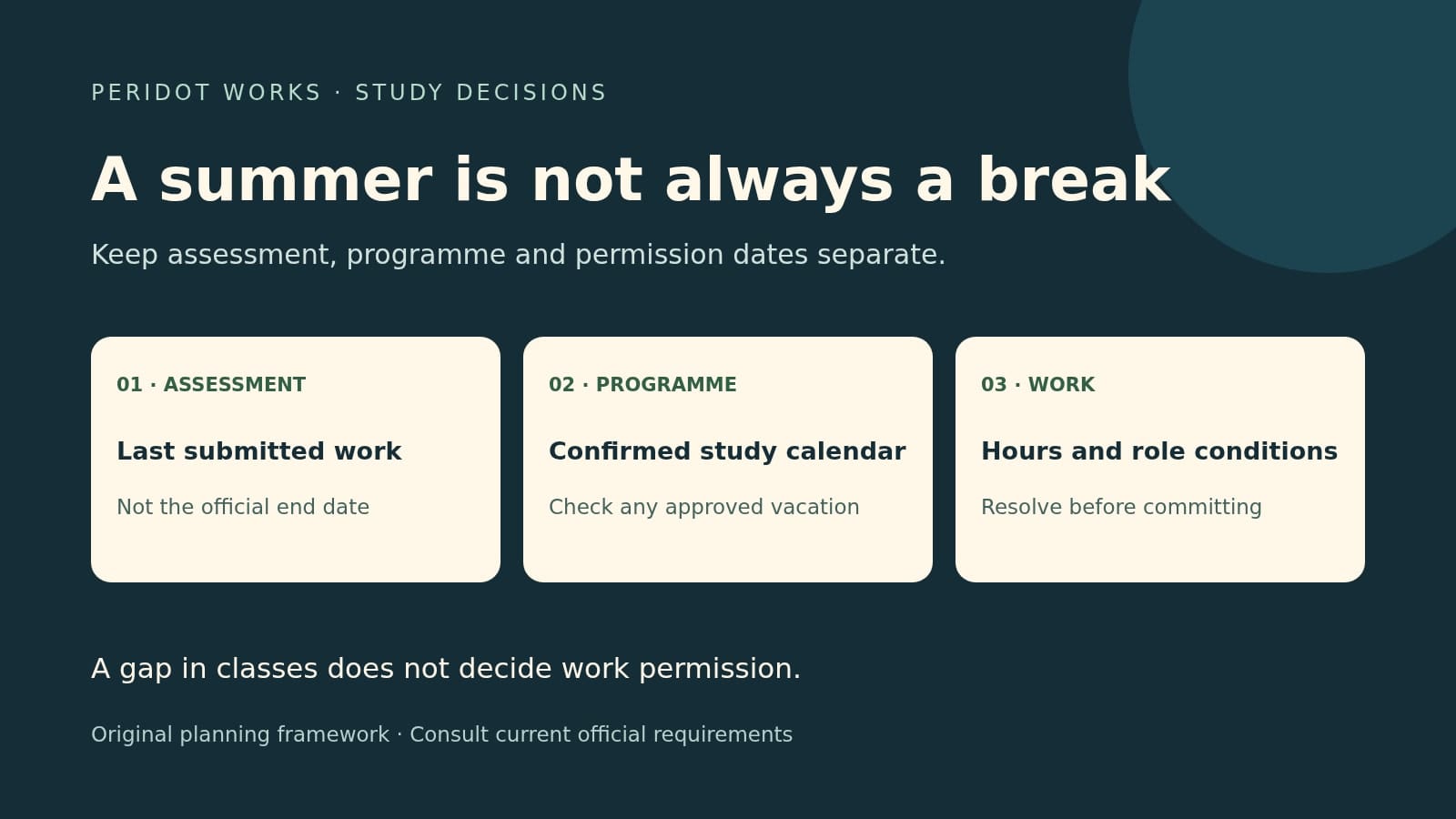
For a 12-month master's student at LSE, finishing exams or submitting a dissertation does not automatically create a summer vacation or permission to start full-time work. LSE says the official programme end date, rather than the final assessment date, governs this distinction. Check your actual immigration conditions and the university's confirmation before accepting extra hours.
This matters when comparing a one-year master's with a longer programme. A shorter course can have a concentrated research and assessment calendar. It should not be costed as a few months of classes followed by an assumed summer of full-time earnings.
Scope: LSE's guidance for 12-month master's students holding UK Student permission, checked 20 October 2026 alongside the Home Office's Student rules. This is not a universal calendar for UK universities, nor individual advice about a particular contract or immigration history.
Put three different dates on the plan
The LSE working-on-a-visa guidance distinguishes the end of teaching or assessments from the official programme end date. It specifically warns that dissertation or capstone submission is not the official end of the programme.
Keep your last assessment date, official programme end date as recorded on the CAS, and immigration permission expiry date in separate fields. Do not replace one with another because the last teaching session has finished. If the dates in your records are unclear or inconsistent, ask LSE's Student Advice and Engagement Team before agreeing a work-start date.
An early dissertation submission may be academically useful, but it is not a self-issued change to the period the university treats as study. An employer's preferred starting date does not change that record either.
Summer without lectures can still be term-time
LSE states that its 12-month master's students do not have an automatic summer vacation because they are still academically engaged with the dissertation. Reading weeks are also not classified as vacations. A gap in scheduled classes therefore does not by itself identify time when term-time work restrictions stop applying.
The Home Office Student rules, at ST 26.1, permit up to 20 hours a week during term-time for the specified full-time degree-level study category, with full-time employment permitted outside term-time. Other categories have different conditions. Check the conditions actually attached to your permission rather than treating the maximum for one category as everyone's entitlement.
LSE also explains that the term-time limit is a total across employers, including paid and unpaid work. Do not allocate the full limit independently to two different contracts. Permission to work particular hours also does not remove restrictions on the type of work you may undertake.
LSE has a specific request process, not a self-declared break
LSE's published guidance says an academic department may authorise a single four-week vacation during a 12-month master's dissertation period. It describes a process through the department, often the Programme Manager, which must send the authorisation to the university's visa-compliance route.
The student must have the required letter before undertaking work beyond the term-time limit. The letter cannot be issued retrospectively. It records authorised vacation dates; it is not a blanket approval for any employer, role or permanent contract.
Treat a requested break as pending until the university has confirmed the actual arrangement and supplied the necessary evidence. Ask whether the proposal fits the dissertation's work and submission schedule. The existence of a request route is not a guarantee that the dates you want will be approved.
Work hours and permission for a role are separate checks
The Home Office rules retain restrictions including self-employment and permanent full-time vacancies, subject to their specified exceptions. A vacation does not erase those conditions. This article does not decide whether an individual role or an application to another immigration route qualifies for an exception.
LSE also says that work performed while physically in the UK for an overseas employer remains subject to the visa's restrictions. Do not assume that remote work for a home-country company sits outside the calculation.
For an offer that depends on full-time availability, give the employer the correct university date evidence and complete the required right-to-work process. Ask the university's advice team about unresolved circumstances before starting, rather than using an article or a submitted assignment as proof.
Budget the dissertation period as part of studying
Keep housing and living costs funded through the actual study period without subtracting an assumed summer salary. The full-course budget guide helps distinguish tuition, living costs and payment timing. The UK post-study funding-runway article addresses the separate gap after study before confirmed earnings.
An available work route is not a vacancy, a job offer or a first payday. This calendar check helps avoid building a family budget around work that has not been offered or may not fit the student's conditions.
Your next action is to place the assessment date, official programme end date, any formally authorised vacation and permission expiry on one timeline. Add the employer's proposed hours and start date in another row. Have unresolved conflicts checked through LSE before committing to the work or counting the income.
Method: original Peridot Works synthesis prepared with AI assistance from the linked university and government guidance. No student's case, guaranteed vacation, job outcome or immigration approval is represented.