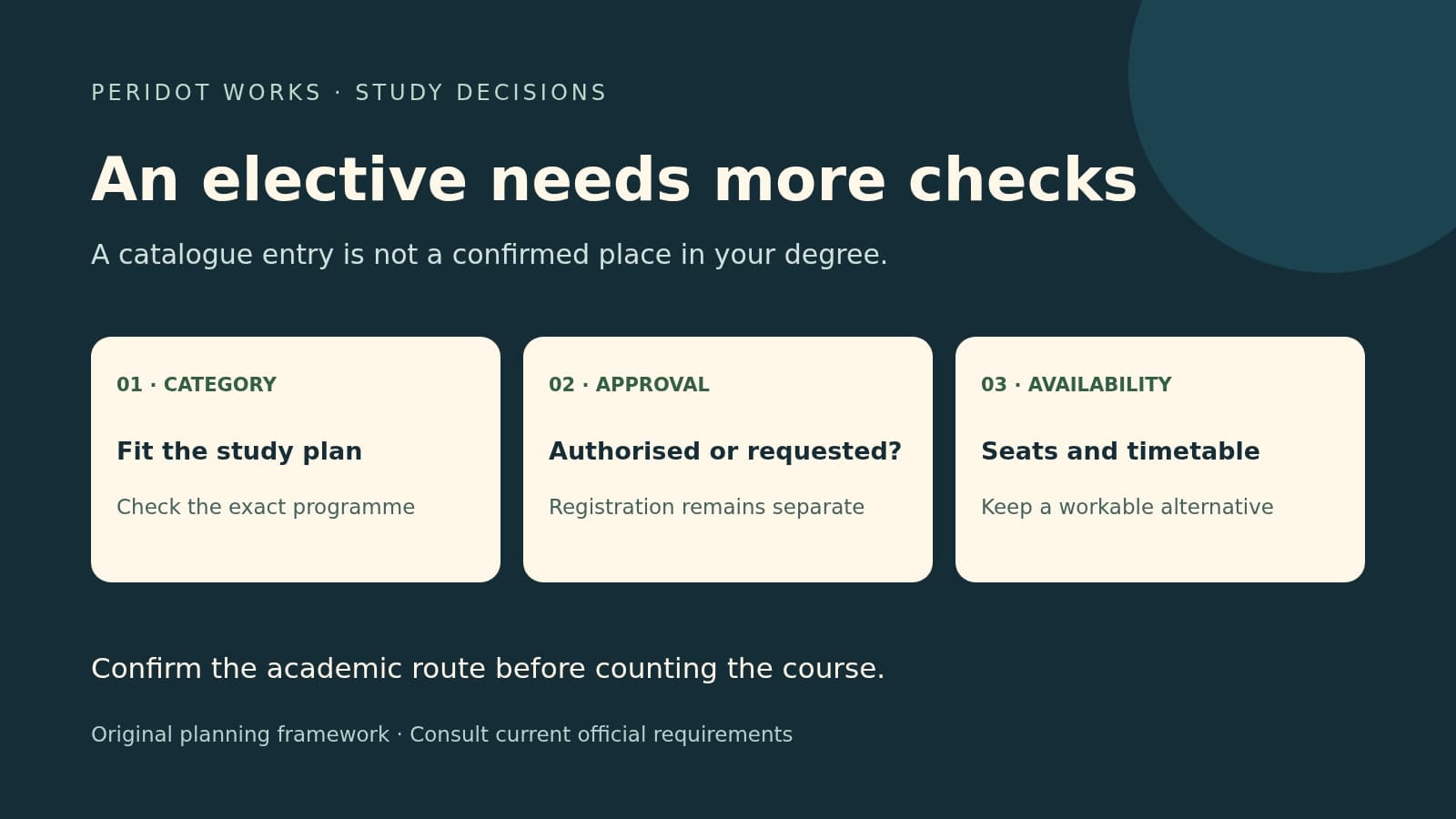
An interesting course in EPFL's catalogue is not automatically an available, credit-bearing elective for your master's. For IC master's students, the published outside-plan procedure distinguishes authorised courses, individual approval, capacity restrictions and registration. Check all four before making a particular elective essential to your study decision.
This is especially useful when a computing student wants to add another discipline, study at UNIL or take an ETH Zurich course. The right question is whether the proposed combination fits the exact degree, prerequisites, timetable and approval route, not simply whether the course exists somewhere in the Swiss university system.
Scope: the School of Computer and Communication Sciences, or IC, master's guidance and EPFL's general subject-registration rules, checked 20 October 2026. The exact programme regulations and section decision remain controlling. This is not a universal allowance for every EPFL master's or an assurance that a seat is currently available.
First establish which category the course belongs to
The IC courses-outside-the-study-plan page allows up to 15 ECTS in that category, counted towards Group 2 – Options. It separately states that CS-, COM- and DH-coded courses included in IC master's study plans are not considered outside-plan courses and may be taken without prior approval.
Do not use the credit ceiling as permission to choose any course up to that amount. Establish the category for the exact module and your programme. Students enrolled in a minor face a separate restriction on additional outside-plan courses, with the stated exception for CS-, COM- and DH-coded courses offered by IC.
For your private shortlist, record the official course title and code, credits, the category you think it fits and the source supporting that classification. Leave the classification unresolved if it has not been confirmed. A topic's relevance to your career does not by itself settle its place in the degree.
Approval and registration are two separate steps
IC directs students to check its authorised-course list. If the course is listed, the published route is registration through Other Subjects in IS-Academia. If it is not listed, the student must request authorisation and, once authorised, still register. The section administration then places the approved, registered course in Group 2 – Options.
A supportive conversation with a teacher does not necessarily complete every required step. Conversely, finding a subject in a system is not proof that the section has approved it for your circumstances. Keep the academic permission and the completed registration as distinct records.
For doctoral-level courses, the page describes a further professor-consent and registration process, with section approval also required if the course is not on the authorised list. Do not transfer the ordinary elective process to a different course category without checking its specific requirements.
Capacity and timing can prevent the intended combination
IC warns that some other-section courses have limited seats reserved for students whose study plans contain them. In that situation registration is not possible. It also says students are responsible for arranging a workable class and exam timetable; clashes cannot be ruled out.
The general EPFL registration guidance requires students to register themselves even for compulsory subjects, after completing the academic re-registration form. Programme-specific subject deadlines may apply. It also distinguishes course registration from signing up on a projects portal.
No calendar deadline or late-registration charge is quoted here. Check the current semester and exact subject procedure, including any earlier programme-specific requirement. If your degree choice depends on one elective, identify an academically useful alternative before assuming the preferred timetable will work.
Another university adds its own procedure
For a master's-level UNIL-HEC course, IC describes registration on the EPFL side as well as the relevant UNIL procedure. Its guidance says courses taken at another university are recorded as equivalents and do not enter the calculation of grade averages. Do not treat their transcript treatment as identical to an ordinary numerically graded EPFL course.
For ETH Zurich, the same IC page permits a maximum of two courses, provided they have no equivalent at EPFL, with a request explaining the choice. It also restricts taking ETH courses in the first master's semester and distinguishes the joint Cyber Security arrangements. Do not plan an entire semester at ETH from a general cross-university course description.
These are academic rules for the stated route, not an individual approval. Ask the section how the proposed course is handled in your exact programme before budgeting travel or reorganising the rest of your study plan around it.
Connect the elective to learning, then keep other decisions separate
Use the course-comparison guide to describe the capability you want to develop and the actual assessed work that would demonstrate it. A catalogue title is weaker evidence than a relevant syllabus, prerequisites and assessment method. None of those establishes employer demand, a job offer or work permission.
Funding can have a different definition of qualifying study. If you hold an EPFL excellence fellowship, use the separate second-year renewal guide and confirm its conditions; academic elective approval alone should not be treated as a funding-renewal decision.
Your next action is a five-field elective record: course and intended learning; study-plan category; authorisation required or received; registration and capacity; and timetable plus fallback. Confirm unresolved entries with the section before making a cross-disciplinary course combination a reason to commit to the master's.
Method: original Peridot Works planning checklist prepared with AI assistance from the linked EPFL guidance. No private student portal, current seat inventory, individual approval or employment outcome was accessed or represented.