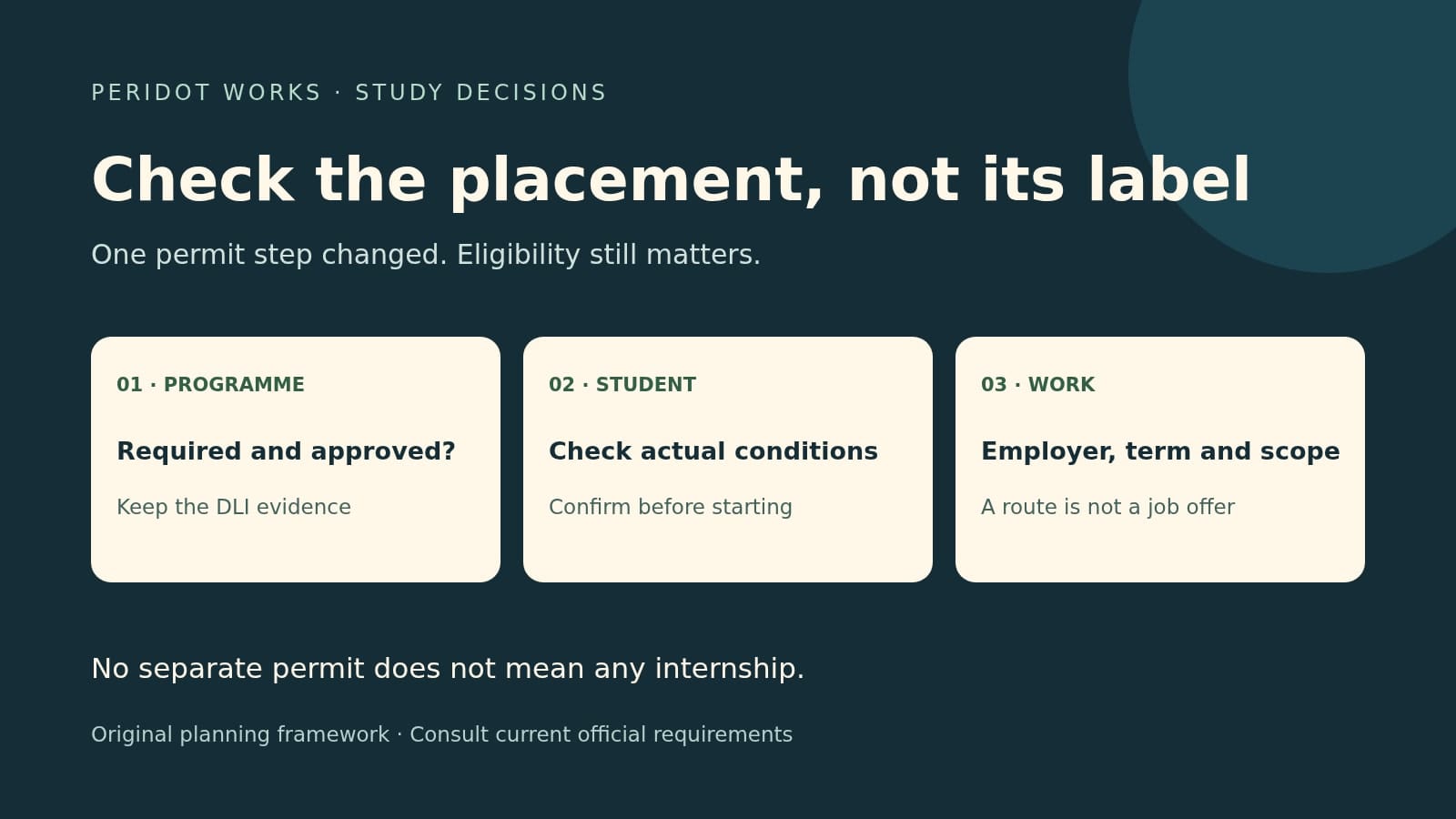
Since 1 April 2026, eligible post-secondary international students in Canada no longer need a separate co-op work permit for required student work placements. The placement must still meet the programme and immigration conditions. An independently found internship is not automatically covered because it would be useful for your career.
For a master's student, the first question is therefore whether the exact work is a required, approved part of the programme. The second is whether the student meets the applicable conditions when the placement begins. Removing one permit step does not secure an employer, approve an optional job or remove the need to check the study permit.
Scope: current IRCC guidance and UBC's Vancouver student guidance, checked 21 October 2026. UBC's process is an institutional example, not a procedure for every Canadian university. This article does not determine an individual's eligibility or change a pending application.
What changed, and what did not
IRCC's 9 April 2026 notice says the change took effect on 1 April for eligible post-secondary students undertaking placements required by their programme. It describes an administrative simplification, not an expansion in the number of students authorised to work.
The current placement guidance distinguishes post-secondary students from secondary students, who still need the separate co-op permit. Do not apply the secondary-school application instructions elsewhere on that page to a master's student without checking the relevant section.
The placement route concerns required work approved by the designated learning institution, or DLI. A brochure mentioning internships, employer contacts or career support does not establish that your particular proposed work falls within it.
Confirm the programme requirement in writing
IRCC lists conditions including the relevant work conditions printed on the initial study permit, a DLI letter confirming the placement requirement, a valid study permit or an in-time extension application, full-time study in the specified post-secondary programme category, and placement work totalling no more than 50% of the study programme.
Those conditions belong together. A letter about the academic requirement is not a substitute for checking the permit, and a study permit is not a substitute for programme approval. If a condition is missing or unclear, use the institution's international-student advice route before starting work.
At UBC, the co-op and student-work-placement guidance describes formal programme or co-op approval and registration in the relevant required placement course or term. It directs students who are unsure whether work is required to their faculty academic adviser or graduate programme adviser.
Ask for a record that identifies the approved placement, employer, course or term, and the programme requirement it satisfies. Keep the university's written approval; do not rely on the job title alone.
An optional opportunity needs a separate check
UBC gives an example outside the placement category when the opportunity is independently arranged, is not mandatory for the academic programme and does not appear on the transcript. That is not an invitation to classify every other arrangement yourself. The programme office must establish the status of the actual work.
Likewise, paid versus unpaid is not the deciding test. UBC explains that approved required placements can include different payment arrangements. Calling work an unpaid internship does not, by itself, make it academically required or authorised.
Use the existing project-versus-placement guide to ask what the student will actually do, who supervises it and how it is assessed. For this Canadian route, add the university's confirmation of the required placement and the immigration conditions. Neither a research project title nor an employer logo supplies that confirmation.
Check the start date and the conditions of the actual work
UBC's start checklist includes meeting eligibility requirements, receiving programme or co-op approval, enrolling in the relevant course or term and reaching the placement term's start. It also flags medical-exam and permit conditions for particular kinds of work. Check whether those apply to the actual role before accepting a starting date; this article does not assess medical or immigration requirements for an individual.
IRCC says qualifying student work placements have no weekly hour limit under this route, but the placement cannot exceed 50% of the study programme. That does not remove the separate rules governing an unrelated side job. Do not transfer the placement's hours treatment to all work undertaken while enrolled.
Study changes also matter. Leave, a change in full-time status, a school change or permit-expiry questions can affect permission to continue. Check the current stop-and-resume requirements with the appropriate adviser before treating an earlier approval as permanently sufficient.
Plan the experience without promising the outcome
The permit change does not show that a programme guarantees a placement, a paid position or a graduate job. Ask who finds the employer, what selection is required, whether payment is confirmed and what the academic fallback is if no suitable placement is secured. Keep living costs funded without deducting unconfirmed earnings.
Post-graduation work permission is another decision. The Canadian master's PGWP checklist provides separate background; successful placement approval does not establish PGWP eligibility or a future hiring result.
Your next action is a five-field placement record: programme requirement; DLI letter and course registration; approved employer and dates; permit and role conditions; and confirmed funding plus fallback. Have unresolved entries checked before beginning the work.
Method: original Peridot Works synthesis prepared with AI assistance from the linked government and university sources. No student record, private placement offer or employment success rate is represented.