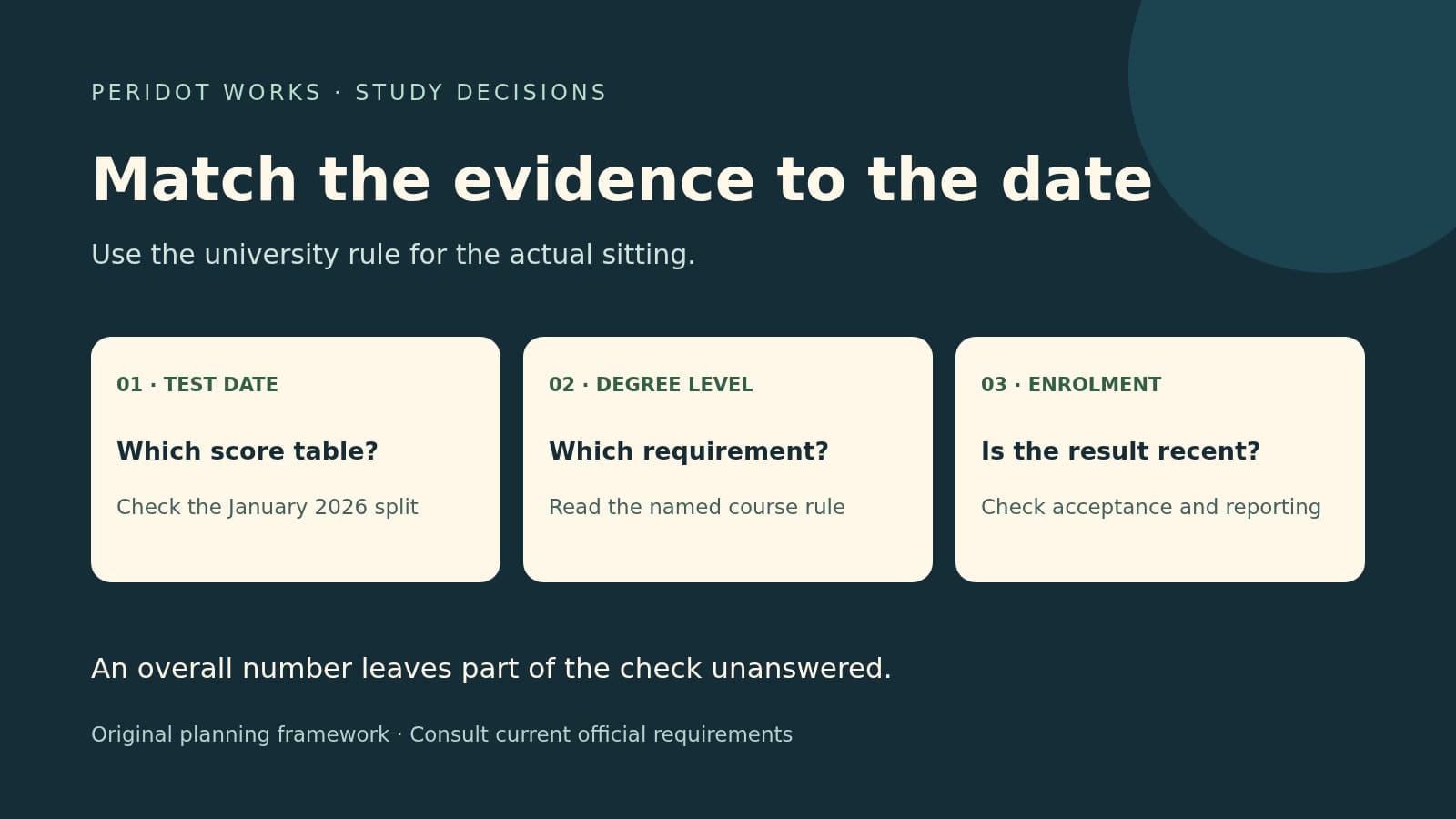
A TOEFL score is not ready to compare with a UCL offer until you know which test-date rules apply, which English level the degree requires and whether the result is recent enough for enrolment. An overall number on its own leaves those questions unanswered.
This guide uses UCL's graduate English-language requirements and ETS's score guidance checked on 17 October 2026. It concerns checking evidence for UCL; it is not an admission decision or a rule for every university. Keep your exact degree, intake and offer instructions beside the general policy.
Record three anchors before comparing a score
Write down the date of the actual TOEFL sitting, the proposed enrolment date and the English level required by the degree. UCL's graduate English-language requirements identify five proficiency levels and direct applicants to the individual degree page for the required one.
Do not choose a level because it resembles a requirement at another institution. If an offer or programme instruction appears inconsistent with the general page, ask the responsible admissions team to clarify the applicable requirement. Keep that written answer with the application record.
The offer-condition checklist helps distinguish evidence you have supplied from a condition the university has confirmed as met. A comparison worksheet is useful preparation, but it does not change the university's status decision.
The test date selects the TOEFL table
UCL says it continues to accept TOEFL iBT tests taken from 21 January 2026, using its new score requirements in full. Tests taken before that date use its older requirements, provided they remain within the permitted timeframe. A result issued later does not change when you sat the test.
For a scoped example, UCL's Level 2 table for tests from 21 January 2026 requires 4.5 overall and 4.5 in each of reading, writing, speaking and listening. Its older Level 2 table requires 96 overall, reading and writing of 24, and speaking and listening of 22. Those are two date-specific requirement sets, not a conversion exercise or a statement that your degree requires Level 2.
Check the exact current row and each named component. Do not round a personal result upward or assume a stronger overall score removes a component requirement. If the required level is different, use that level's row rather than adapting the example yourself.
A comparable total is not permission to ignore the new row
ETS explains the January 2026 score change: updated reports use a 1–6 scale, and during a transition period also show a comparable 0–120 overall figure. ETS says institutions determine their own requirements.
For UCL, use the university's explicit test-date instruction. Do not take a comparable total from a new report and use it to bypass the required new-scale component scores. Keep the report as issued and record the particular UCL row you are checking; avoid creating a homemade conversion certificate or claiming the two tables are interchangeable for admission.
UCL also states that TOEFL MyBestScore is not acceptable for meeting its English requirement. A report displaying combined best scores does not make that combination an accepted route. Compare the relevant sitting's evidence with the university's requirements rather than assembling preferred components across attempts.
Check recency against enrolment
UCL's general test route requires the result no more than two years before the proposed enrolment date. Its page includes a worked date example for September 2026. That example should not be relabelled as the cutoff for a later intake.
ETS separately says TOEFL scores are valid for two years from the test date and it will not report scores after that period. If your result is near the boundary, clarify both institutional acceptance and official reporting in time. Do not assume that applying while a result is current guarantees it remains usable at a later enrolment.
Build those checks into the application calendar, alongside the actual condition deadline and any result-reporting arrangements. A test booking, unofficial score or submitted report is not the same as university confirmation that the condition is satisfied.
Finish with one evidence record
Keep the degree and intake, required level and source, sitting date, original component scores, enrolment date, applicable table and outstanding admissions question together. Store the actual report privately; a public comment does not need your candidate number or score-report image.
If the evidence does not meet the applicable rule, ask which accepted next route fits the remaining time. The pre-sessional planning guide explains the questions to ask about a preparation course; its other university examples do not establish a UCL pathway. Confirm the exact route and progression standard before paying or relying on it.