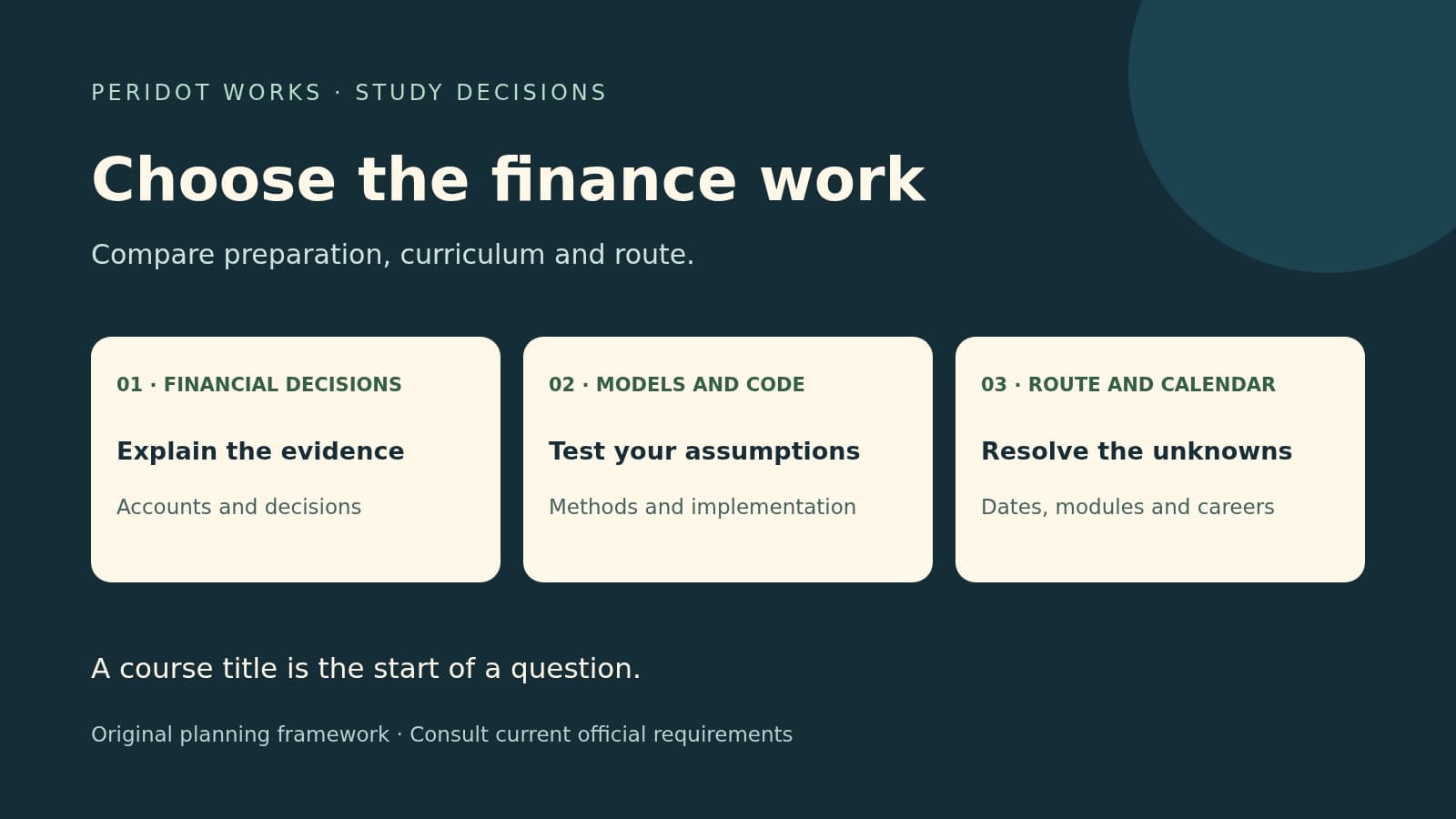
Two finance master's degrees at the same university can develop different kinds of reasoning. At Singapore Management University, Applied Finance and Quantitative Finance both involve financial markets and quantitative work. The useful question is not which title sounds more advanced, but which learning tasks fit your preparation and intended direction.
This comparison uses the official programme pages checked on 17 October 2026. It is an initial course-fit investigation, not an admission assessment, an investment recommendation or evidence that either degree leads to a particular job.
Start with two different questions about finance
The MSc in Applied Finance page lists core study in financial statements, corporate finance, equity and portfolio analysis, fixed income and derivatives, and quantitative and economic methods. The advanced modules build on those foundations. Its curriculum is not a mathematics-free alternative simply because the programme is called applied.
The MSc in Quantitative Finance page lists numerical methods, programming and computational finance, stochastic modelling, risk analysis and asset pricing among its core modules. That combination makes your willingness to work with mathematical models and implementation an important preparation question.
Treat this distinction as a way to investigate the curriculum, not as a ranking. Some topics overlap, and the current pages say module offerings can change. Ask for the applicable module detail and assessment requirements for your intended intake before treating a listed elective as assured.
Try two small tasks before choosing a label
As an original preparation exercise, imagine you are explaining a fictional company's financing decision. List what you would want to know about its cash flows, accounts, financing choices and risk. Write a short explanation of what evidence might change your conclusion. You do not need to buy securities or use confidential company information.
Now imagine testing a simple model with synthetic data. Describe its inputs, assumptions, output and the checks you would use to notice a mistake. Identify which mathematics, statistics or programming steps you could explain today, and which would require preparation. This is not an SMU assessment or a test of admission eligibility.
Compare your reactions. Are you interested in interpreting a financial decision, investigating how a model behaves, or both? Use that observation to choose specific module questions. The course-comparison guide helps connect those questions to actual learning and assessed work.
Separate eligibility from readiness
MAF's admissions section says work experience is not required and considers undergraduate degrees from any field. MQF's prerequisites describe a degree in any field with mathematical rigour. Both pages welcome fresh graduates. None of those statements means every degree, transcript or applicant is automatically suitable.
Make a preparation record from your real coursework and projects. For each relevant skill, identify the course, task and evidence you can explain. Mark missing preparation honestly. An admissions test result and a demonstrated foundation in the work you intend to study answer related but different questions.
Check the current test and English-evidence requirements for the exact route. MQF distinguishes its local and international options; do not transfer one option's language requirements to the other or assume an exemption applies from a general description of your degree.
Resolve the route and calendar before costing it
MQF describes a Singapore local route and an international route involving study at Bayes Business School in London. The published calendar also describes an open module that can be an internship or an academic alternative. An internship reference is not proof that an employer place is allocated to every student.
Both programme pages display duration wording that needs clarification: their headline full-time duration differs from calendar descriptions expressed as study months plus internship. MAF also contains alternative calendar labels. Do not select whichever duration makes a living-cost estimate smallest. Ask the programme to confirm the current intake's teaching, open-module and completion dates and the arrangements that apply if an internship is not obtained.
Use the project-versus-placement guide to separate an academic requirement, university support and a secured employer offer. Any cross-border study or work permission needs its own applicable official check; this curriculum comparison does not establish it.
Investigate careers without borrowing an old outcome
The programme pages identify historical class profiles from 2018–2021 and industry distributions from 2020–2021. Those are not current placement rates or evidence of this intake's prospects. This review has not established current programme-level hiring outcomes or the requirements of employers relevant to your circumstances.
Before making a career-led recommendation, compare the skills and assessed work with current role requirements, including experience, language, geography and work authorization. Ask for a current outcome report with its cohort and definitions. The graduate-employment evidence guide explains why a career label or testimonial cannot fill that gap.
Your next step is a short comparison record: preferred tasks, preparation evidence, intended route, calendar questions and missing career evidence. That makes a counselling discussion specific while keeping admission, funding and employment decisions separate.