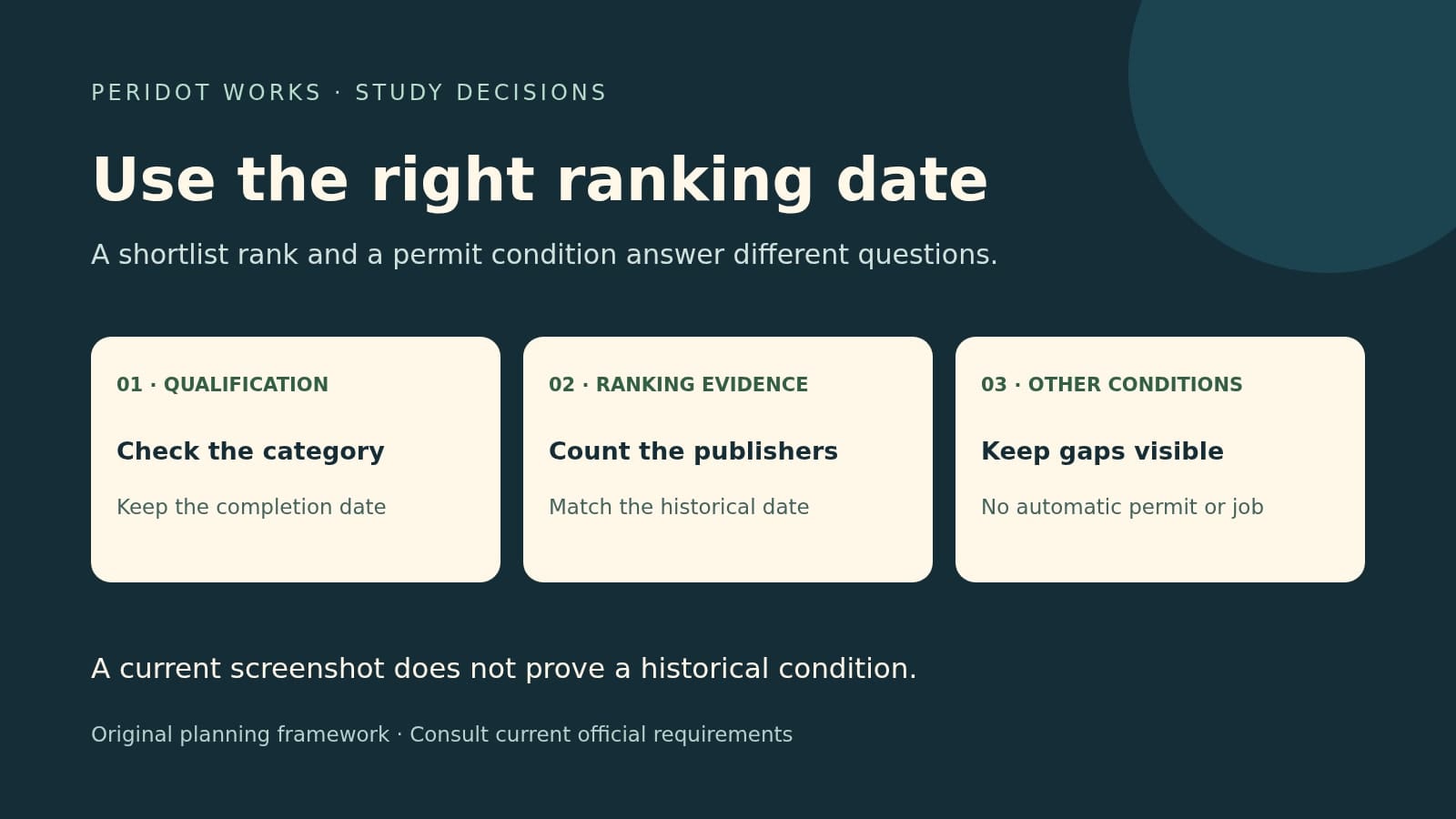
A high university ranking can mean different things in a course shortlist and in a residence-permit rule. For the Dutch orientation-year route based on a foreign master's, a current ranking screenshot is not enough to establish that the relevant institution met the published criteria when you graduated.
This guide helps organise that evidence check. It uses the Netherlands' Immigration and Naturalisation Service, IND, guidance checked on 18 October 2026; the main page shows an update of 7 October 2026. It does not determine your eligibility, authorize work or predict whether you will receive a permit or a job.
Confirm that you are checking the right category
The IND orientation-year page distinguishes Dutch study, designated foreign institutions, research and other qualifying routes. The foreign-institution route includes specified postgraduate qualifications completed within the three years before application, with additional conditions.
The official IND FAQ says a foreign bachelor's degree does not qualify for this route: someone who studied abroad must have at least a master's. Do not transfer the Dutch bachelor's category to a degree obtained elsewhere.
Start a private record with the qualification, awarding institution, completion date and route you are investigating. If you studied through a partner, branch campus or joint arrangement, leave the institutional-identity question open until you have an applicable answer. A familiar brand name is not evidence that every delivery arrangement is treated identically.
Count publishers, not screenshots
For the designated foreign-institution category, IND requires top-200 ranking evidence from at least two of its three named publishers: Times Higher Education, QS and ShanghaiRanking. The ranking must apply on the graduation or promotion date. General and relevant subject rankings can be combined across different publishers; a subject ranking must concern your study or research subject.
Make a small evidence table with one line per publisher. Record the institution as listed, the ranking's name and edition, whether it is general or subject-specific, the position and the date to which the evidence applies. Add the original source link and any unresolved identity or subject question.
Two pages from one publisher should not become two independent publishers in that record. Nor should a strong rank in an unrelated subject silently substitute for the relevant subject. These checks turn a vague claim that a university is highly ranked into a question you can actually verify.
Match the evidence to the historical date
Imagine a purely hypothetical institution that appears in a current top-200 table but whose position at a graduate's completion date has not been established. The current page leaves a gap; it does not resolve the historical condition. Record that gap rather than borrowing today's position.
If an older ranking page is inaccessible, say what is unavailable. An undated screenshot, a search-result date or a university's promotional summary may help you locate the original evidence, but should not be labelled the missing historical source. Ask IND how to document the case where the required evidence or institutional identity is unclear.
The ranking-shortlist guide discusses a different decision: using rankings to investigate learning fit. This permit-related check does not establish teaching quality, personal course fit or employer demand.
Keep other requirements visibly separate
IND also specifies foreign-diploma evaluation and language or qualifying education conditions, with stated exceptions. A ranking match is therefore one part of the check, not a complete eligibility verdict. Follow the current official instructions for the applicable qualification and circumstances; do not assume that an English-taught label or a previous evaluation settles every requirement.
Keep a separate line for each outstanding item and the official source or response needed to resolve it. Preserve your original certificates. Store identifiers and diploma copies in the appropriate private channels rather than posting them in public discussions about rankings.
Do not treat a submitted application as proof that you may begin work. Check the actual permission and required evidence with IND for your circumstances. This article does not assess work authorization during an application or a later move to another residence category.
A job-search plan still needs funding and role evidence
IND describes the orientation permit as valid for one year and not extendable. The three-year qualification window is not three years of job-search residence. Nor is either period a forecast of how long a particular person will need to find work.
Separately investigate relevant roles, language expectations, experience and employer requirements. Use the job-search evidence log to turn real applications and feedback into next actions. Budget with confirmed resources and a fallback, rather than subtracting imagined earnings from essential costs.
Your next useful output is a completed evidence record with uncertainties left visible. A verified ranking condition can support a more precise enquiry; it is not approval of the whole route or a reason to commit to travel before the remaining requirements are understood.