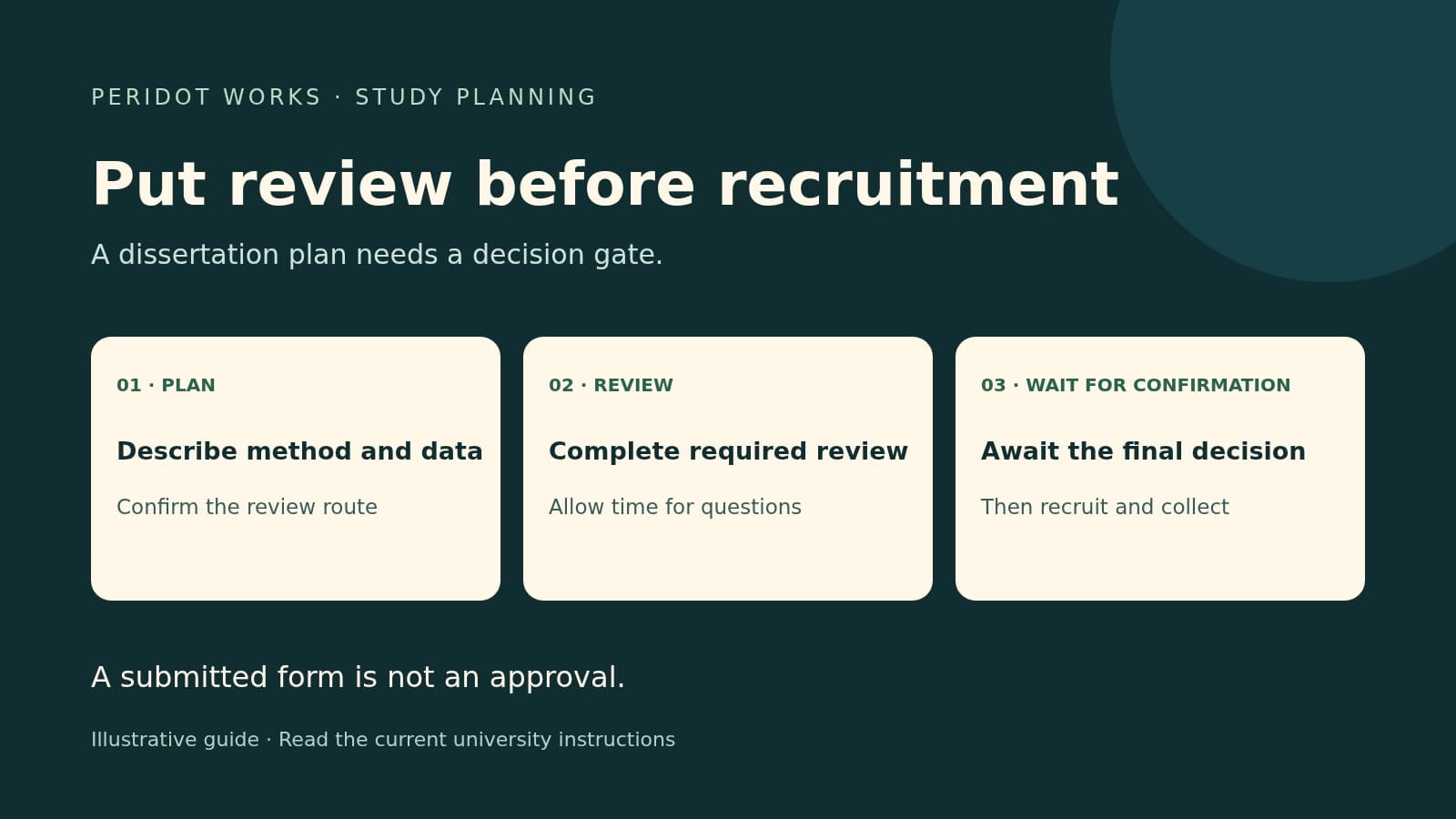
A dissertation timetable needs more than a submission date and a target number of interviews. If the project requires ethics approval, recruitment and data collection must wait for that approval. Leaving review out of the calendar can make an otherwise plausible project difficult to complete as planned.
This guide concerns the London School of Economics and Political Science’s published student process, checked on 17 October 2026, including its May 2026 instructions. It is a preparation guide, not an ethics application, an approval decision or a rule for every university.
Describe the data before choosing the route
Start with a plain account of what you intend to study, where the information will come from and whether anyone could be identified. LSE’s research-ethics guidance covers interviews, surveys, focus groups, experiments and observation of people. It also covers user-generated material from forums, social platforms, blogs and comments, and personal or identifiable information in secondary data.
Removing a name does not necessarily remove the issue. A searchable quotation or a combination of details could still lead to an individual. Conversely, LSE describes a limited exemption for research using only publicly available archival records, including newspapers, unless other ethical issues arise. Publicly visible social-media material should not simply be treated as equivalent to an exempt archival source.
You do not need to gather sample participants or copy identifiable posts into a general planning document to explain your proposed method. Describe the intended data and ask your supervisor which requirements apply before collecting it.
Supervisor review and board review have different roles
The May 2026 student instructions distinguish departmental review from Research Ethics Review Board review. Student applications with few ethical issues may be reviewed by the supervisor or relevant academic adviser through the departmental route. Applications requiring board review go to the supervisor first and are then referred onwards; supervisor support does not replace the board’s approval where that approval is required.
The instructions also distinguish MSc projects that are not dissertations from dissertation research. An exemption from board review for a category of project is not permission to skip every ethics check. Describe your actual project category and let the university’s process determine the applicable route.
The research-supervisor fit guide helps with an earlier question: whether your interests and preparation fit a programme. Ethics review is a later, separate gate concerning the particular study you propose to conduct.
Put the review gate before participant recruitment
LSE’s instructions require ethics approval before any recruitment of participants or data collection begins. Do not put an interview date into the plan as though approval has already happened, or assume that sending invitations is merely administrative preparation outside that rule.
Ask your supervisor about departmental deadlines and review time. For projects requiring board review, the May instructions advise allowing at least four weeks for that process in addition to supervisor review. They distinguish initial feedback from final approval and warn that busy periods can take longer. Those are planning allowances, not a guaranteed turnaround or a reason to promise a participant a fixed date.
Even a system notification that approval may not be required has a further check: the instructions say the supervisor must confirm that conclusion after reviewing the details. Students must await that confirmation before collecting data.
Prepare specific explanations, not generic form answers
Before completing the university process, discuss the proposed method, participant approach, information and consent materials, and handling of identifiable information with your supervisor. Use the current institutional guidance for those documents. A template needs adaptation to the actual study; it is not evidence that every relevant issue has been resolved.
LSE’s student instructions strongly discourage copying AI-generated responses into the ethics form because generic or inconsistent explanations can delay review. Use your own accurate description of the study and obtain the appropriate academic guidance. This article does not supply answers to paste into an application.
Keep a five-field readiness record
Record the proposed data and method; the supervisor or department responsible for advice; the review route awaiting confirmation; the calendar allowance and dependencies; and the decision that must be received before recruitment or collection begins. Leave unresolved items visibly unresolved.
If the approved project later changes, check whether an amendment is needed before implementing the change. Approval for one plan should not be assumed to cover a different method or participant group. The assessment and workload guide can help you fit these dependencies into a wider study plan, while the current LSE instructions determine the research-review requirements.