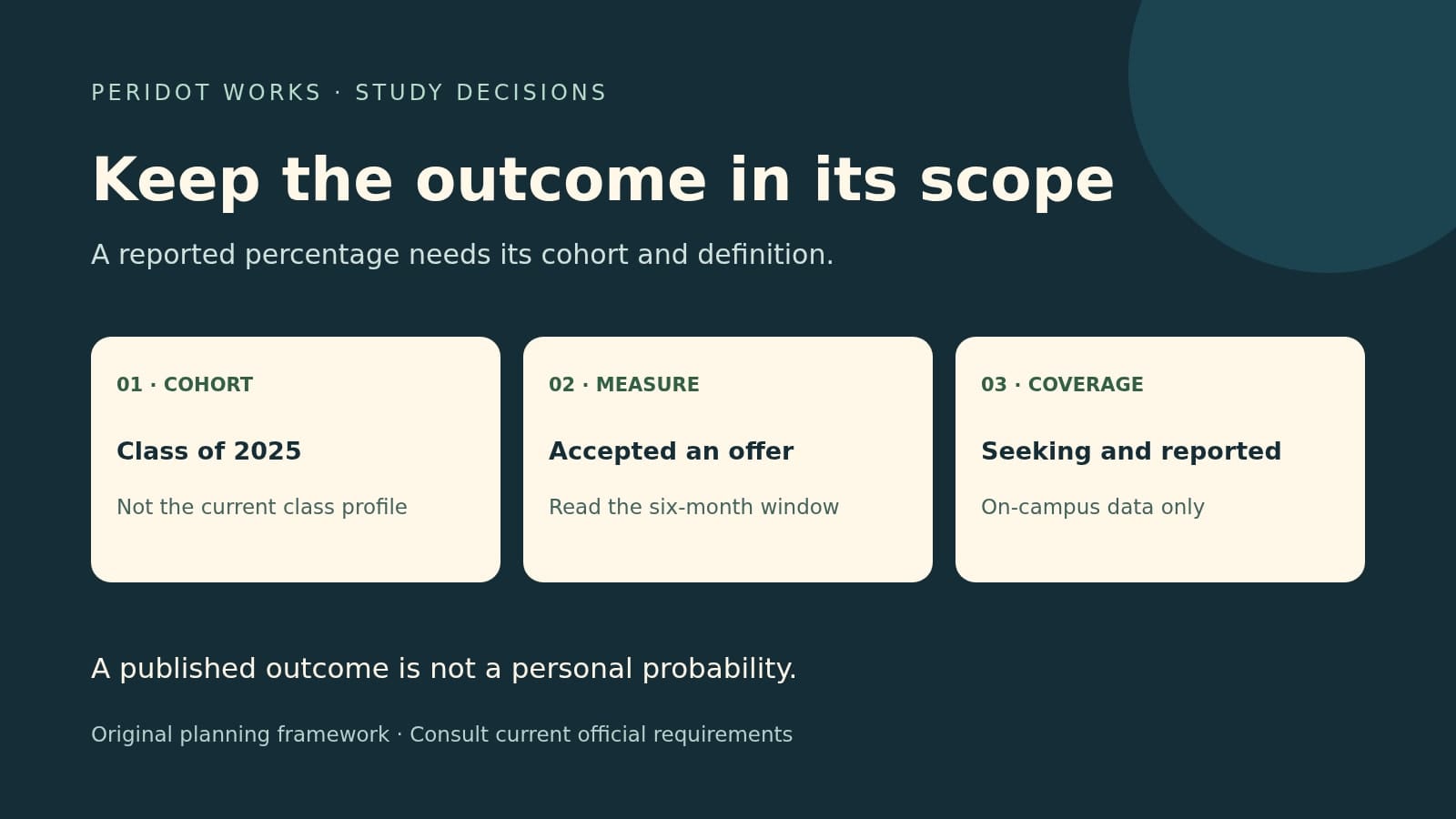
Imperial reports that 97% accepted an employment offer within six months of graduation for its Business Analytics Class of 2025. The careers page limits its figures to on-campus graduates who were seeking employment and shared employment data. Keep that definition attached to the percentage: it is not a 97% employment probability for every applicant or every future international student.
This is useful evidence when shortlisting, but only for the question it actually answers. Before using it to justify a master's or a family borrowing plan, separate the cohort, the reporting group, the employment measure and the geography. A current course page and a historical employment result can appear together without describing the same students.
Scope: Imperial's programme and careers pages, checked 21 October 2026. These are school-reported outcomes, not an independent audit or a forecast. The review did not verify a programme-specific international-student employment rate, visa-sponsorship rate or an individual's chance of selection.
Keep the cohort and the reporting group together
The careers page labels the employment report Class of 2025 and says its statistics refer to the on-campus programme. It also states that the figures concern graduates seeking employment who supplied employment data.
That is narrower than all enrolled students or all graduates. Students not seeking employment and graduates who did not provide data are not automatically represented by a percentage defined this way. This does not make the reported result false; it defines the evidence you can use.
The reviewed text did not establish the numerical denominator for that reporting group or its response rate against the complete Class of 2025. Those are useful follow-up questions. Do not invent the missing count by applying the percentage to another class profile.
In particular, the programme page also displays a Class of 2027 profile with 151 students. That is not the denominator for the Class of 2025 outcome. Keep the profile year and the outcome year in different fields in your comparison notes.
Accepted an offer is a particular measure
The published 97% statement concerns accepting an offer within six months of graduation. It does not, by itself, report when the graduate started the job, received a first salary or recovered the cost of study.
It also does not say that every accepted role was an entry-level data-analyst job in the reader's preferred city. The page lists several kinds of role, including Business Analyst, Data Engineer, Project Manager and Senior Business Intelligence Analyst. A role list is not a breakdown showing how many first-time job seekers entered each role, what prior experience they had or whether the work matched each person's intended career.
Record the actual outcome label before comparing it with another university. A statistic about offers received, an accepted offer or employment at a survey date may answer different questions. The graduate-employment data guide provides the broader comparison framework; this example adds the exact published Imperial scope.
UK employment is not a sponsorship statistic
Imperial's careers page also reports that 67% are employed in the UK. That geography statement should not be relabelled as the share of international graduates sponsored by an employer.
The reviewed pages did not establish a nationality-specific outcome, the immigration routes used, or a joint measure of people holding a particular role in the UK. Do not multiply headline percentages to manufacture an individual probability or a count of sponsored positions.
For an international applicant, investigate the actual role requirements and work route separately. A historical graduate destination does not show that a future employer will sponsor a particular applicant. No immigration eligibility or future vacancy is determined by this article.
Current course content does not rewrite historical outcomes
The current programme is presented as MSc Business Analytics & AI, while the careers section labels its historical report MSc Business Analytics, Class of 2025. Compare the actual curriculum and assessed work for the intake you are considering; do not assume every current module or option was part of the earlier graduates' experience.
Nor does a published outcome establish that a particular new elective caused those results. Admission selection, prior preparation, work experience, geography and the job market may all matter, but the two pages reviewed do not isolate their effects.
No course recommendation follows from the percentage alone. Use the result as one source alongside curriculum fit, relevant employer requirements, costs and the evidence still missing for your situation.
Your next action
Make an outcome record with five headings: programme and cohort; who was seeking and who reported; the exact outcome and time window; country and role detail; and unanswered questions. For this example, ask about the qualifying denominator, reporting coverage and any available international-graduate breakdown before treating the data as a complete picture.
Keep the UK post-study funding runway separate from this historical percentage. Plan for delayed earnings using actual confirmed funds rather than entering a statistically implied salary into the family budget.
Method: original Peridot Works interpretation prepared with AI assistance from the two linked primary pages. No alumni testimony, student identity, independent placement audit, salary estimate or ranking promise is represented. Historical public discussion informed the question only; it was not evidence of current demand or outcomes.