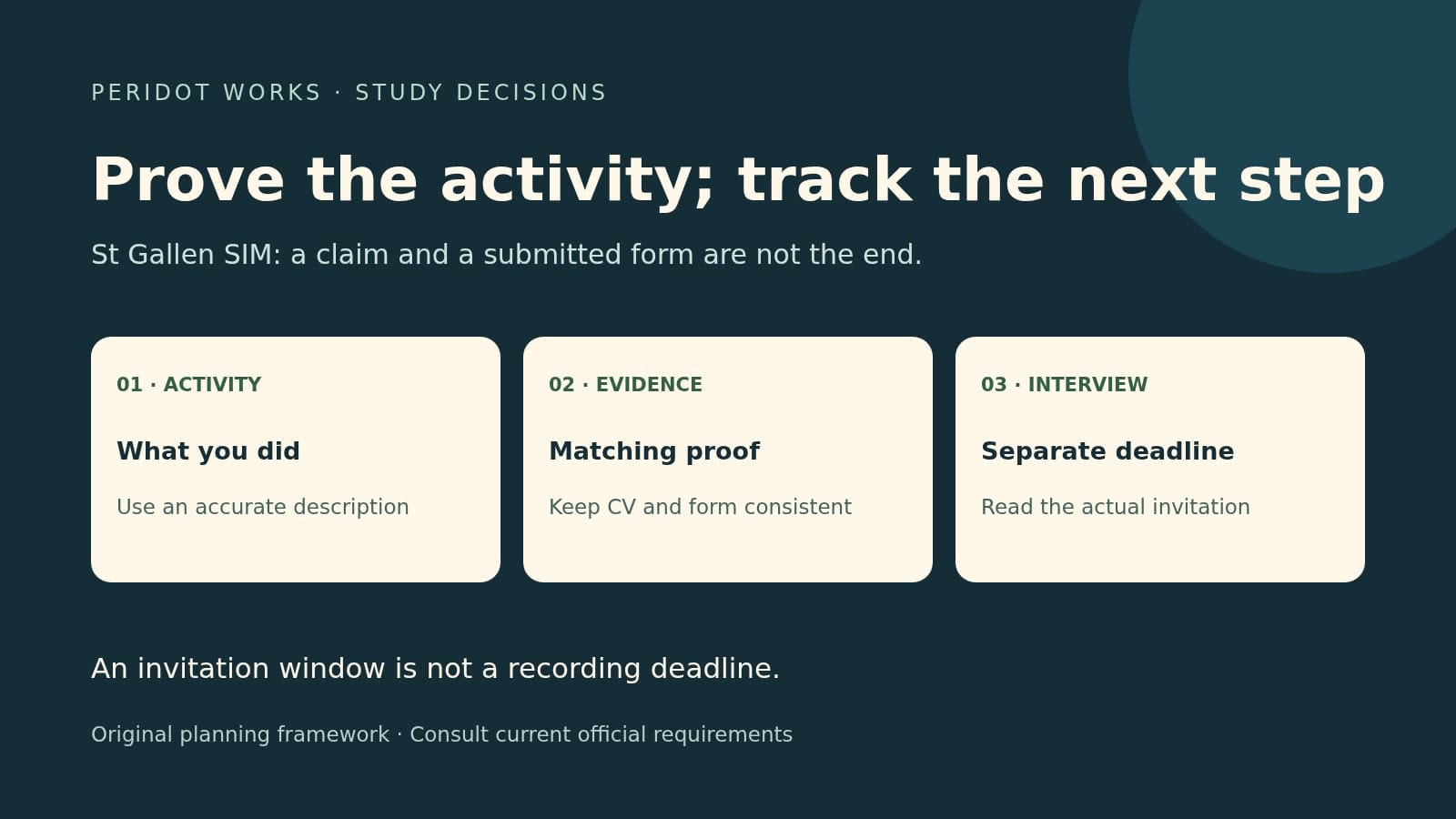
For the University of St Gallen's Strategy and International Management master's application, a polished CV is not enough evidence for every claimed activity. The university says extracurricular activities and work experience are considered only when proof is furnished. It also treats the video interview as a separate step with a deadline communicated in the invitation. Prepare the supporting evidence and the interview handoff together, rather than treating submission of the online form as the end of the application.
This guide concerns the current official SIM admission instructions, checked on 22 October 2026. It explains an evidence workflow, not your eligibility or admission chances. Requirements apply to the relevant admission period and may change; verify the programme and period before using them. No applicant portal, invitation or personal documents were accessed.
Formal eligibility comes before selection
The university first checks formal admission regulations and completeness before forwarding an application to the SIM Admissions Committee. Its eligibility page distinguishes prior-degree types and subject-credit conditions. A management-related degree title alone should not be treated as confirmation that your degree qualifies.
Resolve that classification using the university's exact current requirements before investing in a selection strategy. If your degree's recognition, discipline or credit mapping is uncertain, record it as unanswered. Strong activity evidence does not replace formal eligibility, just as the university's assessment weights do not predict an offer for an individual applicant.
The broader course-comparison guide helps keep academic fit and the work you want to learn separate from the process of getting admitted. This article does not evaluate the programme's employment outcomes, employer access or sponsorship; no such evidence follows from an admissions rubric.
Read the four criteria without turning them into odds
The current university page gives four selection weights: GMAT or GRE results at 20%, undergraduate average grade at 20%, extracurricular activities and work experience at 25%, and the video interview at 35%. These are the school's assessment weights, not percentages of applicants admitted and not a formula for calculating your chance of admission.
The practical implication is that test preparation should not displace the other evidence work. Equally, do not invent an activity score from the length of your CV or assume that a high test result compensates for an unresolved degree requirement. The page does not provide an individual admission probability, and none is inferred here.
For test submission, distinguish uploading a report from arranging official delivery. The university's instructions address both. Check the exact accepted test, validity and reporting conditions on the current page rather than borrowing a rule from another Swiss institution. No test booking, test-score threshold or round-specific calendar is prescribed in this article.
Connect each activity claim to proof
The university asks applicants to list relevant commitments on both the online application and the CV, and to upload proof. Its examples include work experience, internships, exchange semesters, extracurricular commitments and social activities. It asks for an English CV using the SIM style template.
An original preparation record can make those requirements easier to check. For each proposed CV line, record what you did, the period, your actual responsibility, the evidence available and whether the same description appears in the application. Keep an unresolved-evidence column. A title without proof should not quietly become a verified achievement during editing.
Choose accurate descriptions over inflated impact. An internship certificate may establish a role and dates without proving every business result claimed in a bullet. A team project does not establish that you personally led every component. If a result cannot be substantiated, describe the contribution you can support. Do not manufacture certificates, outcomes or leadership responsibilities to fit a perceived ideal candidate.
Keep documents and identifiers in your own private preparation process and the university's authorised application route. This checklist is not a request to send employment letters, passports, referee details or transcripts to a public comment thread.
Referee contacts are not automatically recommendation letters
SIM asks for two contacts on the CV: an academic reference and a professional reference. The university says it may contact them at the committee's discretion; that is not a statement that every referee will be called or that unsolicited letters replace the requested contacts.
Confirm that each person agrees to be listed and can discuss the relevant work. Ask them to verify your factual description, rather than rehearsing invented achievements. Use the reference-planning guide for the general preparation, while following SIM's actual format. Do not assume another university's letter-upload process applies here.
Separate the invitation clock from the recording deadline
The university says an invitation to complete the video interview arrives within five days of successfully submitting the application. That is the stated invitation timing, not a universal five-day completion deadline. The invitation supplies the specific recording deadline, which may differ from the regular application deadline. The university also says the application is processed only once the video interview has been received.
Prepare a quiet space, working microphone and camera, and a reliable connection before the invitation arrives. The school describes pre-recorded questions that ask for opinions and reflections. Practise explaining real decisions and learning from your own experience; no leaked questions, memorised fabricated story or guaranteed interview script is offered here.
After submission, keep a private handoff record: submission confirmation, expected invitation window, invitation actually received, stated recording deadline and confirmation of completion where available. If an expected message is missing, use the university's official support instructions rather than assuming an extension. Do not derive a deadline from a historical applicant forum table.
Your next action is to reconcile every proposed activity claim with its proof and identify who will monitor the invitation and recording deadline. Those are controllable preparation tasks; an admission outcome remains the university's decision.
Source and method: current official university admission page independently reviewed on 22 October 2026; original AI-assisted interpretation and evidence workflow. A historical public applicant thread inspired the question but supplies none of the requirements, percentages or deadlines above. No private student story, demand estimate or admission/employment guarantee is used.