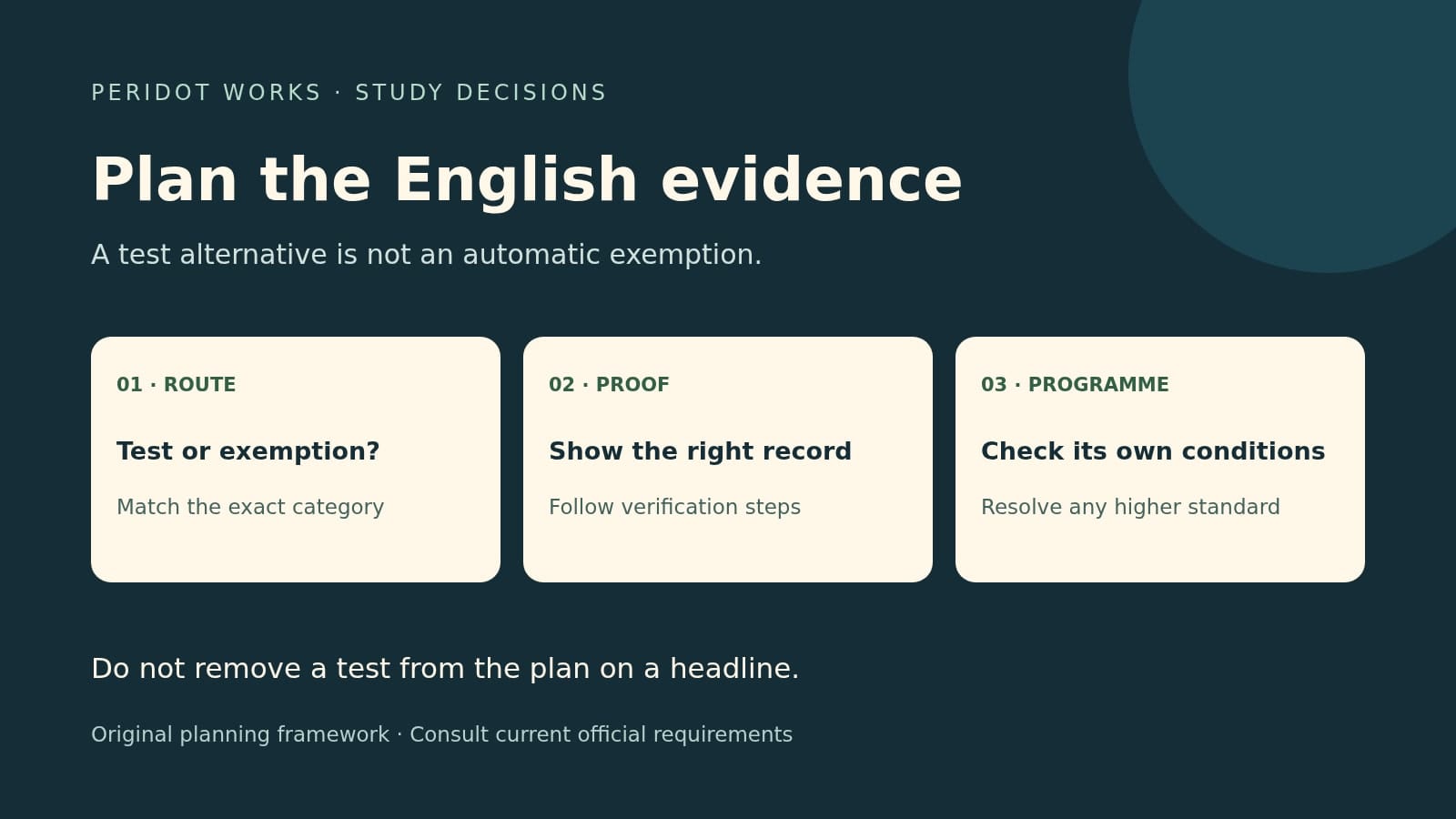
At the University of Bergen, an English-taught master's applicant must document English proficiency through an accepted test or a documented exemption. IELTS is one possible route, not the only one. But an English-medium bachelor's degree or a university letter does not automatically establish an exemption for every applicant.
For an Indian student comparing Norway options, the useful question is therefore not simply whether a course is advertised as available without IELTS. It is which evidence category the exact university accepts for your educational history, and whether the intended master's programme sets a higher requirement.
Scope: UiB's master's programmes taught in English and its published non-EU/EEA application guidance, checked 20 October 2026. These are Bergen's rules, not a universal Norway waiver. Programme-specific requirements and the current admissions instructions must be checked before an application decision.
Start with the route you can document
UiB's English-language requirements list accepted tests and exemptions separately. The page accepts IELTS Academic or IELTS Online, TOEFL iBT including Home Edition, and PTE Academic, subject to its specified conditions. That does not make every test version or score combination interchangeable.
For IELTS, the published requirement is an overall 6.5 with at least 6.5 in each component. UiB says it does not accept IELTS One Skill Retake for this requirement. Do not stop reading at the overall score if a component is below the stated minimum. Test results must also be valid and no older than two years at the application deadline.
This article does not reproduce TOEFL score conversions. Check the current official instructions for the version and date of the test you actually intend to use rather than transferring a threshold from another institution.
An exemption is a particular category, not a general certificate
The same page describes several exemption routes, including specified Cambridge qualifications, IB results and qualifying education in particular countries. The details differ: some concern upper-secondary education, some a defined amount of university study, and others a particular completed degree.
For an applicant whose only proposed exemption evidence is an English-medium Indian bachelor's degree, the published list does not show a blanket category for that situation. Do not assume that a medium-of-instruction letter creates one. Equally, do not conclude that every Indian citizen must take IELTS: a person's wider educational history may meet another listed category, and another accepted test may be suitable.
Match the exact wording of a category to your actual completed education. Record the institution, country, level, duration and teaching language, together with the document that proves the relevant facts. If you cannot identify a matching route, mark the exemption unconfirmed and ask admissions about the exact situation before relying on it.
A UK-linked qualification is not always study in the UK
One especially useful detail is the UK country-specific exemption. UiB describes qualifying education in the United Kingdom but explicitly excludes UK branch-campus, validated, franchised and distance-learning students from that exemption.
A British awarding university's name on a degree therefore does not by itself answer the question. Record where and how you actually studied. This is an English-evidence distinction in Bergen's published policy, not a judgement about the quality or recognition of the qualification.
Use the same discipline for every category: do not quietly replace the university's stated educational circumstance with a broader marketing description.
Accepted evidence still has a delivery process
Bergen explains how to document each accepted test. For IELTS, upload an official result with a legible TRF number so the university can verify it. For TOEFL, the page specifies both adding UiB as a score recipient and uploading the result. For PTE, it specifies sharing the score through the Pearson account as well as uploading the report.
An exemption also requires evidence in the application. An applicant who meets a category should not leave the English section empty on the assumption that admissions will infer it from a CV.
The non-EU/EEA application page adds that a programme requiring higher test results than the general minimum cannot be treated as covered by the general exemption. Check the intended programme's instructions as well. No application or document deadline is quoted here; record the current dates for your actual route rather than borrowing a date from another institution or an old intake.
Keep the language decision in its proper place
Meeting the English requirement does not establish academic eligibility, an admission offer, a tuition exemption or funding. Compare those conditions separately. The master's application calendar can hold test booking, result availability, verification and document-upload tasks against their actual dates.
Admission English is also different from the language needed for a future job. The teaching-versus-workplace language guide helps frame that separate investigation; this article makes no Norwegian employment or earnings claim.
Your next action is a four-line evidence record: exact programme and intake; accepted test or exemption category; documents and verification steps; and the unresolved question for admissions. Resolve that question before removing test preparation from your plan.
Method: original Peridot Works synthesis prepared with AI assistance from the linked current university guidance. No individual eligibility assessment or promise of admission is represented.