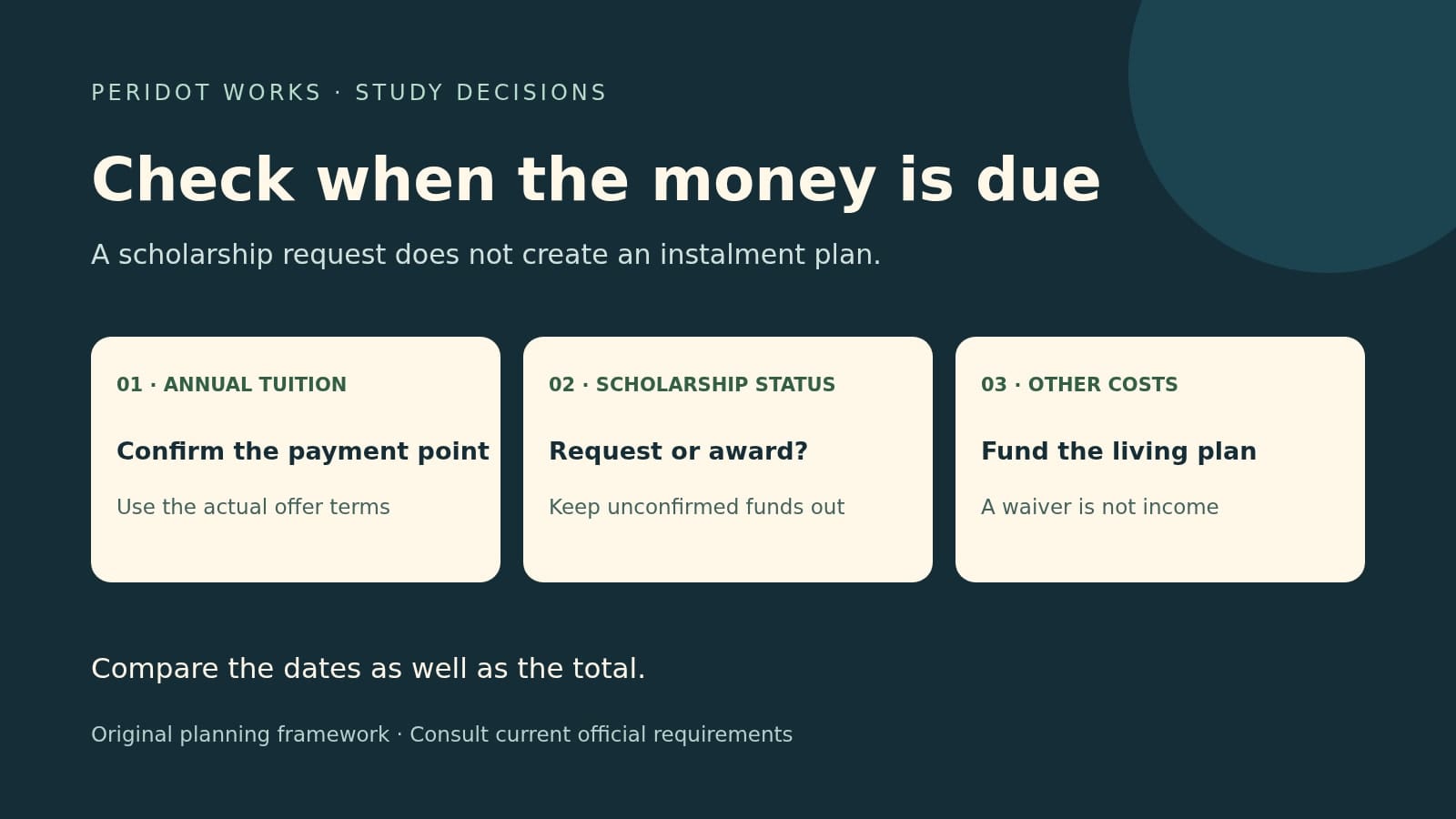
A family considering an Aalto master's needs to answer two different questions: will the university award a tuition waiver, and how will any tuition still payable be funded when it is due? A scholarship application does not turn an annual bill into monthly instalments.
This guide concerns applicants Aalto classifies as tuition-fee liable. It uses the university's published instructions checked on 19 October 2026, rather than assessing your fee status or recommending a loan. International joint programmes can have separate fee and scholarship arrangements; check the actual route before applying these instructions.
Begin with the annual payment requirement
Aalto's scholarships and tuition-fees guidance says tuition is paid as a single instalment for the following academic year and cannot be split into multiple instalments within that year. Fee-liable students cannot enrol until the fee is paid.
That makes cash timing a material part of the original course decision. A household may have a credible plan for saving over a year while still lacking the amount needed at the university's payment point. Do not treat those two situations as equivalent.
Identify the relevant programme, field, study-right start and official fee row. Keep the annual basis and currency beside the amount. Then obtain the applicable payment instructions and deadline for the actual offer. A planning assumption or an amount remembered from another applicant should not replace that evidence.
The tuition-instalment guide uses UBC as an example of a different arrangement. Its three-term schedule should not be imported into Aalto's annual-payment instructions. Similar total fees can produce very different dates on which a family needs accessible funds.
A waiver is selective and has its own application step
Aalto describes its Excellence Scholarships as competitive full tuition-fee waivers, not living-cost funding. Applicants must request the scholarship during the admission application period; it cannot simply be added afterwards. Aalto says programmes may award none, and the scholarship decision comes with the admission decision.
Keep your record accurate while waiting. “Scholarship requested” belongs in an unresolved-funding field, not as a confirmed reduction to tuition. A strong academic record does not itself establish an award, and an admission offer should not be relabelled as a waiver.
When a decision arrives, read the actual coverage and conditions. Aalto's published scholarship duration refers to the normative study period and requires full-time study following an approved study plan. Do not treat that as permission to assume unlimited fee coverage if your personal timetable changes.
The scholarship evidence guide helps distinguish permission to apply, an application, a selection decision and usable confirmed support. Here, add the annual tuition-payment requirement to that distinction.
Build two funding versions before committing
Prepare a no-award version using the applicable tuition obligation and payment date. Beside it, prepare a conditional waiver version that you will update only when an actual award decision supports it. Keep living and other costs visible in both versions.
For each version, identify accessible funds at the tuition deadline, which other expenses the same money must cover and the earliest unresolved gap. Do not count one family contribution twice or describe a conditional loan release as cash already available. If funding becomes available gradually, compare its release dates with the university's single-payment requirement.
As an original hypothetical exercise, imagine that a family's monthly contributions would eventually cover a fee, but the full annual amount is not available at the required payment point. The useful next action is to resolve the timing gap or reconsider the commitment. Assuming an unconfirmed university instalment arrangement does not resolve it.
No amount, salary, award probability or processing time is assumed in this example. Use the actual written terms for any funding proposal rather than increasing an estimated borrowing total until the spreadsheet appears to balance.
A tuition waiver still leaves a living-cost decision
Study in Finland's funding guidance, updated in September 2026, separates tuition support from living expenses and cautions against making part-time work the main funding plan. That national guidance is context; it is not a personal budget, a secured job or an individual residence-permit assessment.
List housing, everyday spending, travel, insurance and other applicable charges using current evidence for your situation. Ask which costs a particular benefit actually covers. A reduction in tuition does not make those other obligations disappear or establish that money is accessible when each payment falls due.
Your next useful output is one dated funding record: the applicable annual fee, actual payment deadline, scholarship status, confirmed accessible funds and earliest gap. If the no-award version does not work, leave that limitation explicit while investigating alternatives. The purpose is a decision you can explain honestly, not a promise that applying for support makes the course affordable.